Liese Dictus (KU Leuven)
Erasmus’ sharp pen was a force to be reckoned with by his contemporaries. In his famous Praise of Folly the humanist author spared no one in society, including himself. Similarly, Erasmus proved in his letters that he could deal harsh blows with his pen strokes. A letter to the French humanist Guillaume Budé begins as follows:
Nae tu homo πάνυ βασιλικῶς munificus es, eruditissime Budaee, qui pro tam indocta epistola tam eruditam, hoc est iuxta Glaucum Homericum pro vix aerea reddideris plusquam auream, tum pro mediocri tam uberem tamque prolixam; imo non epistolam, sed volumen atque, ut melius dicam, thesaurum. (Epistula 531)
Really, my most learned Budé, what princely generosity! You have repaid my ill-educated letter with one of such exquisite learning, giving me like Glaucus in Homer more than gold for what was hardly bronze and have rewarded my mediocre performance with something so flowery and so long, it was not a letter, it was a volume, or rather a thesaurus. (translation by Mynors and Thomson)

Although Erasmus‘ opening sentence appears to be erudite and full of praise at first glance, his grotesque wording and ambiguous compliments are striking on closer inspection. The comparison of himself and Budé with the Homeric heroes Glaucus and Diomedes, as well as his climactic and exaggerated description of Budé’s previous letter as a thesaurus suggest that the friendship between the two humanists turned out to be more complex and more equivocal than one would expect.
Epistula 531 constitutes a key element in the correspondence between Erasmus and Budé. It marks the first rupture in a turbulent friendship that turned genuine affection into frustration and rivalry. Erasmus and Budé first met in Paris at the end of the 15th century. The preserved correspondence between the two humanists began around April 1516 with a letter from Erasmus to his French colleague. Budé’s experience in legal matters and his interest in philology and theology, which he shared with Erasmus, provided the two humanists with plenty of material for conversation. Soon they began to comment on each other’s work. Throughout their correspondence, the well-meant criticism became sharper and more bitter. Both Budé and Erasmus took offense at certain remarks, and misunderstandings between the two scholars continued to grow. After Epistula 531, Budé ended his communication with Erasmus. Eventually, the correspondence was resumed and carried on for a decade, although the later letters mainly dealt with mutual friends and shared opponents. The contact between Erasmus and Budé was full of friendly banter until real blows were struck and their friendship died a long and painful death.
The first signs of disagreement in the correspondence of the two humanists concern the proper use of writing style, both in Latin and Greek. Whereas Bude’s writings can be described as grand and weighty, Erasmus’ style can be characterised as lucid and accessible. The latter’s rather simple style prompted Budé’s comment in the previous Epistula 493 that Erasmus’ writings weren’t erudite enough and focused mainly on ‘futilities’, i.e. rather simple and popular genres. Although Budé formulated it in a kind manner by – likely ironically – praising Erasmus’ works, this remark seems bold and derogatory. Erasmus was dismayed and counterattacked his French colleague. The result is Epistula 531, in which Erasmus vacillates between exaggerated praise and harsh criticism. Beneath a sugar-coated layer of words hides a sharp invective.
The literary clash between Erasmus and Budé was fought with learned weapons, as befits a humanist letter. The use of Greek, for instance, proved to be formidable ammunition. Both humanists were well versed in this classical language and therefore did not hesitate to employ it in their correspondence. In a way, the use of Greek reflected the duality that the correspondence of Erasmus and Budé implied. The usage of Greek alongside Latin was not only employed in a hostile way, it also strengthened the bond between the correspondents in question. Greek was a language used only by a select audience. The bilingual communication between Erasmus and Budé was thus an acknowledgement of each other’s scholarship. From a single quotation to a full letter in Greek, their fondness for Ancient Greek manifested itself in various ways in their correspondence.
Erasmus employs code-switching in his letters to show his scholarship or to reflect his emotional commitment. Code–switches provide variety and allow him to emphasise or camouflage certain elements. A concrete example in Epistula 531 is the appearance of the Greek word ἐνθυμήματα in the following sentence: “tantum in ista tua apologia praestas artificem, cui non satis fuit omnia mea ἐνθυμήματα refellere, nisi mea tela protinus in me ipsum retorsisses, subito que ex iudice faceres reum.” Erasmus’ criticism is apparent in this statement, claiming that Budé wasn’t satisfied with defending his own stances and deemed it necessary to attack Erasmus. The latter tried to reduce his part in the conflict by presenting his remarks as less compelling, describing them as mere ἐνθυμήματα, which can be translated as ‘suggestions’. Additionally Erasmus uses several Greek proverbs from his Adagia but a number of quotes from ancient authors also appear in his letters. Besides the appearance of a Greek word in the absence of a Latin synonym, Erasmus’ fondness for compound adjectives and words with concrete, almost tangible meanings is also evident in Epistula 531. The context in which the use of Greek is situated is crucial as well. When a particular domain is associated with the Greek language, such as philosophy or rhetoric, this often results in the appearance of Greek terminology. The Greek language is furthermore a valuable medium for messages that are not meant to be read by everyone. Full sentences in Greek hide Erasmus’ negative sentiments in Epistula 531 toward some members of the clergy, who he condescendingly calls ματαιολόγοι instead of the more positive θεολόγοι.
The conflict between the two humanists forced them to get the best out of their pens. A literary battle unfolded, fought out with words, quotations and code-switches. The use of Greek proved to be an extra weapon in the arsenal, which could be used both to win people over and to inflict an extra blow on an opponent. It was a versatile tool that could be used in different ways. Code-switches are so context-specific that, in Epistula 531, they form the fine line, as it were, between friendship and enmity. As with any conflict, there were casualties. In this battle, the friendship between Erasmus and Budé perished, but the battle fought deserves a place in the literary history books.
Pictures
- Picture 1: Hans Holbein the Younger, Portrait of Desiderius Erasmus of Rotterdam with Renaissance Pilaster, 1523, oil on wood, 73.6cm x 51.4 cm. London, National Gallery, L658.
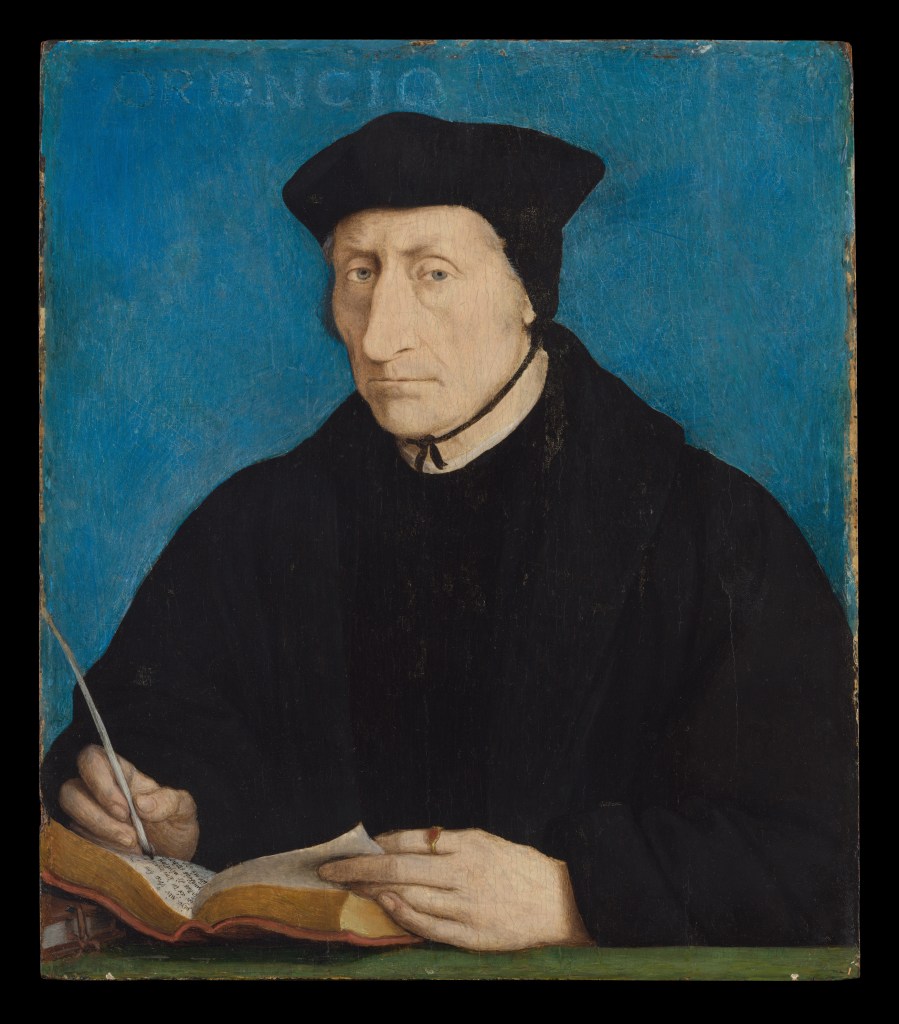
Source: https://commons.wikimedia.org/wiki/File:Holbein-erasmus.jpg (last accessed: januari 2025) - Picture 2: Jean Clouet, Portrait of Guillaume Budé, ca. 1536, oil on wood, 39.7 x 34.3 cm. New York, The Met, Maria DeWitt Jesup Fund, 1946, 46.68.
Source: https://www.metmuseum.org/art/collection/search/435914 (last accessed: januari 2025)
Bibliography
- The full letter can be found in Allen, P.S. et al. (ed.). Opus epistolarum Des. Erasmi Roterodami Vol. 2. Oxford: Clarendon, 1906.
- The translation of Epistula 531 can be found in Mynors, R.A.B. and D.F.S. Thomson (transl.). The Correspondence of Erasmus IV. Toronto and Buffalo: University of Toronto Press, 1977.
- On the use of Latin-Greek code-switching in Erasmus’ letters: Rummel, Erika. “The Use of Greek in Erasmus’ Letters.” Humanistica Lovaniensia 30 (1981): 55–92.
- On Erasmus’ and Budé’s dispute: Carrington, Laurel. “The Writer and His Style: Erasmus’ Clash with Guillaume Budé.” Erasmus of Rotterdam Society yearbook 10, no. 1 (1990): 61–84.
- On Erasmus’ and Budé’s correspondence: De La Garanderie, Marie-Madeleine (vert.). La correspondance d’Erasme et de Guillaume Budé. Paris: Vrin, 1967.
How to cite
Dictus, Liese. 2025. “Erasmus and Budé: Frenemies forever!” Hermes: Platform for Early Modern Hellenism (blog). 1 Februari 2025.
Deposit in Knowledge Commons: https://doi.org/10.17613/jmq9n-1×174
 Hermes
