Adriaan Demuynck (KU Leuven / FWO)
On 27 February 1565, the new city hall of Antwerp was formally inaugurated, exactly four years after the first stone was laid. To adorn the opening of this prestigious Renaissance building, two young poets joined forces and wrote a collection of city encomia or laudes urbis on the city of Antwerp. The first poet, Georg Schrögel (Georgius Schroegelius), was a stranger in Antwerp: he was born in the Bavarian town Neudek (present-day Nejdek in Czechia) and had only arrived six months earlier in the port town on the river Scheldt.1 His English friend Daniel Rogers (Daniel Rogerius), on the other hand, had strong familial ties to Antwerp, since his mother was born there. Rogers wrote a Latin Oda Sapphica and nine other poems in honor of Antwerp, but these were an appendix to the magnum opus of Schrögel: a 714-line laudatory poem, titled Elegia ἐγκωμιαστικὴ in clarissimam et praestantissimam Belgarum urbem Handoverpiam Georgii Schroegelii Boii (‘Elegy in praise of the most renowned and excellent city of the Belgians, Antwerp, by Georg Schrögel from Bavaria’), written entirely in Ancient Greek.
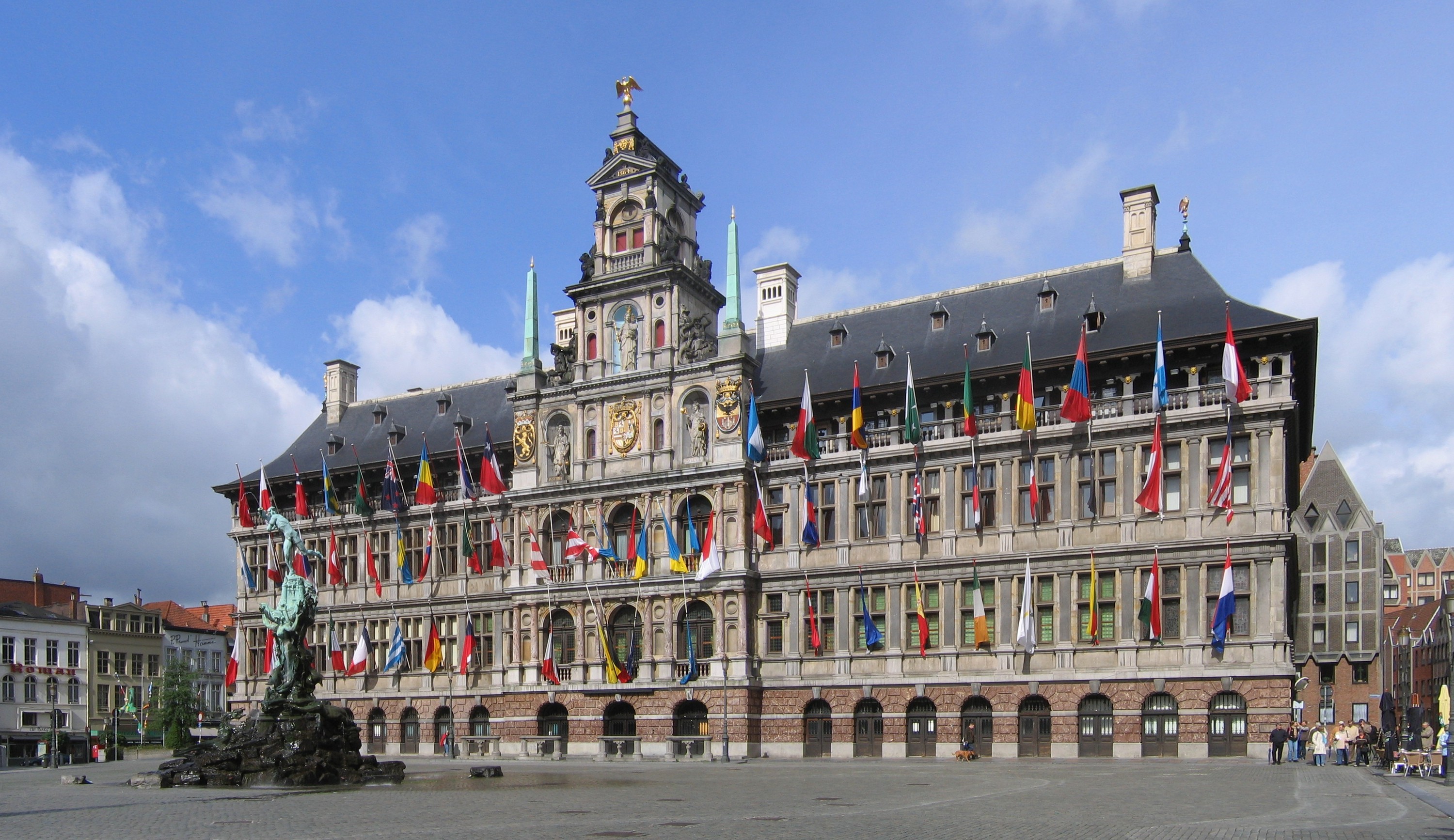

The collection of city encomia was printed by Christophe Plantin in January 1565, just in time for the inauguration of the city hall. The laudations of Schrögel and Rogers graced this ceremony, and especially Schrögel’s Greek poem must have added lustre to this event. Understandably, the two young authors devoted ample attention in their poems to the description of the new city hall. Rogers wrote a Latin poem titled De curia nuper extructa, seu de domo civica, which compares the new city hall to the seven wonders of the ancient world. Schrögel included an ecphrasis of the building in his Greek poem, which opens with these verses (ll. 149-158):
Ἐν μέσσῃ ἀγορᾷ τὸ πολιτικὸν οἰκοδόμημα,φύει χρυσοφαές, θαμβάλεον μέγεθος
ὅττι ὑπερτέλλει οἴκων πανυπείροχον ἄλλων,
θάμβος καὶ παρέχει πᾶσι βροτοῖσι μέγα.
Τοῦ μῆκος μὲν ἀπειρέσιον, πλάτος ἄπλετόν ἐστι,
τοῦ δὲ κάρηνα τρέχει οὐρανὸν αἰπύτατον.
Ἠΰτ’ ἐν ἀκροτάτῳ τῷ οὔρει πῦρ ἀΐδηλον
καίεται, οὕ οὗ αὐγὴ λάμπει ἐπ’ ἄστρα πόλου·
ὣς αἴγλη φαιδροῦ διὰ αἰθέρος εὐρὺν ῎Ολυμπον
ἥκει χρυσαυγοῦς παμφανόωσα δόμου.
[…]
Georg Schrögel, Elegia ἐγκωμιαστικὴ, fol. B3v
“In the middle of the market stands the city hall, it shines with gold, a marvelous grandeur as it towers above the other houses, evoking great awe in all mortals. It is immeasurable in length, gigantic in width, its roof running across the highest heavens. Just as a devastating fire rages on the mountaintop, its glow reaching the stars in the sky, so too does the brilliant radiance of the golden-shimmering house pierce through the clear air up to the broad Olympus.”2
On the page preceding the start of the Greek city encomium, Rogers wrote a short poem in Latin to congratulate Schrögel on his tour de force. In his wishes, Rogers emphasizes the fact that Schrögel wrote his encomium in Greek. This way, the immigrant Schrögel surpassed earlier, local poets like Cornelius Grapheus and Melchior Barlaeus who had praised Antwerp in Latin.
In Elegiam Handoverpianam Georgii Schroegelii Boii.Docta tuas laudes facundi Musa Graphaei
ante dedit Latiis urbs generosa notis:
nunc tibi Schrogelii laudes decantat easdem
Pieris, imparibus vecta Pelasga rotis.
Scilicet Aonio celebrandis carmine divis
laudibus et meritis nata Thalia fuit.
Dummodo tu facias dignum Respublicae laude,
Pierii deerit non tibi turba chori.
Daniel Rogerius
Georg Schrögel, Elegia ἐγκωμιαστικὴ, fol. A4v
“On the Elegiac Poem on Antwerp by Georg Schrögel of Bavaria.

Earlier the learned Muse sung your praise through the Latin characters of the eloquent Graphaeus, eminent city. Now the Pierian goddess sings through Schrögel praise for you, again, but this time it is a Greek muse, carried on unequal wheels. Certainly, Thalia was born to celebrate gods with Aonian poetry and deserved praise. As long as you do what is worthy of praise, dear Republic, you will not lack a Pierian choir.
Daniel Rogers.”3
After writing the laudations on Antwerp, Rogers seems to have acquired a taste for laudes urbium. Some ten years later, Rogers wrote a collection of 35 Latin poems on 31 English cities like London, Oxford and Coventry, fittingly titled Urbes. The collection remains unpublished and is preserved in a hefty manuscript containing plenty of writings by Rogers, now kept at the Huntington Library in San Marino (CA), USA (mssHM 31188). This time Schrögel returned the favour to Rogers, embellishing the collection of city encomia with a laudatory poem for his friend Rogers. Schrögel sticked to the language of which he had showcased his proficiency earlier, Greek. As a result, the language distribution in the Urbes is reverse compared to the Elegia ἐγκωμιαστική: a Greek congratulatory poem for a series of Latin city encomia.
Schrögel emphasized Rogers’ merit in having visited the cities he praised. He described the results of these visits as a bidirectional process: Rogers profited from his visits to these cities, because they left lasting impressions on him, and the cities profited from Rogers’ visits, since his poems bring them eternal glory.
Ad urbes Danielis Rogerii, Georgii Schroegelii Boii EpigrammaΠολλὰς ὠφελείας Δανιὴλ μὲν ἀφεῖλε Ῥωγῆρος
ἐκ τοῦ εἰσοράειν χώρια ἅττ’ ἔγραφε·
δηλαδὴ εἰσενόησε νόμους, ἔθη, ἤθεα λαῶν
ἐξ ὧν κόσμησεν νοῦν, κρίσιν, ἠδὲ φυὴν.
Ὑμεῖς ἀλλὰ, τόποι πολυόλβιοι, εἵλετε αὐτοῦ
ὠφελείας πλείονας, κέρδεα καὶ πλείονα.
Οὕτος ἐφεῦρ’ ἐμπειρίην μεθ’ ἑοῖο θανοῦσαν·
ἀλλ’ ὑμεῖς κύδη ἔνθεα ἀθάνατα.
Οὕτω ὄναιο νέος πολὺ ἡνίκα πλείονα ὄψει
χωρία καὶ τούτους κύδεα ταῦτα πόρει.
mssHM 31188, fol. 195v, Huntington Library, San Marino (CA), USA.4
“An epigram by Georg Schrögel of Bavaria on the Urbes of Daniel Rogers

Daniel Rogers gained a lot of advantages out of looking at the cities that he described.
Clearly he observed the laws, customs and characters of peoples, on the basis of which he adorned their mind, judgement, and nature.
But you, most blessed places, have got a lot more advantages than him, and a lot more benefits.
He found an experience that  will die with him, but you found a divine, immortal fame.
This way, young man, may you profit a lot, when you will see much more places and lend them such renown.”
Schrögel described Rogers as a true Odysseus: Rogers visited many cities in England, in order to study and get to know the different people and their customs. Based on his impressions of these towns, he wrote these city encomia, which bring eternal glory to these cities. Even though Rogers profited from his visits by being able to study the different customs of cities, the profit for the cities from these poems is more durable than Rogers’ perishable impressions. Rogers’ poems will bring these cities a lasting fame that will outlive the experiences of their author.
This Greek poem of Schrögel is the last sign of the friendship between him and Rogers. The two young poets found pleasure in writing city encomia: firstly in a joined effort praising Antwerp, ten years later in a collection on English cities. While Rogers sticked to Latin, Schrögel found a platform for showcasing his knowledge of Greek in these poems. The composition of city encomia also provided the friends with the opportunity to praise each other. At first, Rogers praised Schrögel on his Greek encomium. Later on, Schrögel praised his English friend for writing a large collection of city encomia. This way, the oeuvre of both authors was marked by praises of cities and friends.

© The Huntington Library, Art Collections, and Botanical Gardens
Footnotes
- Schrögel (1565: A3r), ll. 55–56: Dumque tuos video fines auguste Senatus, / iam reficit sextam menstrua luna rotam. (“While I am looking over your territory, venerable Senate, / the moon already makes its sixth monthly cycle.”) ↩︎
- Translation cited from Demuynck and Van Rooy (2025: 117). ↩︎
- Translation cited from Demuynck (2024: 43, n. 67). ↩︎
- The transcription of the manuscript is mine. I regularized the spelling, and added spirituses and punctuation. ↩︎
Figures
- Figure 1. Antwerp City Hall.
Source: https://commons.wikimedia.org/wiki/Antwerp_City_Hall#/media/File:Antwerpen_Stadhuis_crop1_2006-05-28.jpg/2. CC BY-SA 3.0 - Figure 2. Peeter I van de Borcht, Domvs Senatoria Antwerpiensis. 1582/1588, paper, 23,4 x 31,8 cm. Antwerp, UAnwerpen print collection, MP 12.2.
Source: https://anet.be/record/opacuaobj/tg:uapr:561/E - Figure 3. mssHM 31188, fol. 195v (detail), Huntington Library, San Marino (CA), USA.
© The Huntington Library, Art Collections, and Botanical Gardens
References
- Rogers, Daniel. 1565. Danielis Rogerii Albimontani De Laudibus Antverpiae Oda Sapphica Ad amplissimum et ornatissimum Virum D. Johannem Van Hove. Accesserunt etiam alii eiusdem versiculi quidam. Antwerp: Plantin.
- Schrögel, Georg. 1565. Elegia ἐγκωμιαστικὴ in clarissimam et praestantissimam Belgarum urbem Handoverpiam Georgii Schroegelii Boii. Antwerp: Plantin.
- Demuynck, Adriaan. 2024. “Inverting the Hierarchy: Greek and Latin in a Sixteenth-Century Poetical Encomium of Antwerp.” Journal of Latin Cosmopolitanism and European Literatures (10): pp. 29-57. DOI: 10.21825/jolcel.89653.
- Demuynck, Adriaan and Van Rooy, Raf. 2025. “In search of a genre: Georg Schrögel’s Elegia ἐγκωμιαστικὴ in Handoverpiam (1565) between Bavaria and Brabant.” In Griechischhumanismus des 16. Jahrhunderts. Lorenz Rhodoman im Kontext und digital, edited by Stefan Weise. Stuttgart: Franz Steiner Verlag, 2024.
How to cite
Demuynck, Adriaan. 2025. “Laudes urbium, ἐγκώμια φίλων: Two friends writing city encomia and congratulating each other.” Hermes: Platform for Early Modern Hellenism (blog). 1 August 2025.
Deposit in Knowledge Commons: https://doi.org/10.17613/4pept-tny04
 Hermes
