Criticizing the Pagan Father of the Gods in Lorenz Rhodoman’s Ilias parva (1588/1604)
Karen Lelittka (Bergische Universität Wuppertal)
The Greeks began their education with Homer. Homer retained his reputation as the king of poets throughout the Middle Ages, although his texts could not be read directly except in Byzantium. It was not until the Renaissance that his œuvre returned to the West, where the first translations into Latin were produced laboriously. From that point on, a new exploration of Homer’s texts began. The poet and philologist Lorenz Rhodoman created a special kind of exploration: in his Ilias parva, which was first published in 1588 in Greek and in 1604 in Greek-Latin verse, he used the ancient tradition of composing argumenta and summarised the 24 books of Homer’s Iliad as well as the 14 books of Quintus Smyrnaeus’ Posthomerica in just 1,700 hexametric verses.

Despite Rhodoman’s self-identification as a Christian, he recommended reading Homer’s (pagan) works. In his poem “Dedicatory poem for the Latin translation of Dion’s speech on Troy” he praised Homer and his knowledge while also drawing attention to the ancient poet’s incorrect theological understanding (Rhod. Dion.praef. 1–3; 17f.):
Χρήσιμα πολλὰ λέγει σενοῖς ἐπέεσσιν Ὅμηρος
πρὸς βίον ἀνθρώπων· ὁ γὰρ ἦν παίδεσσιν Ἀχαιῶν
ἰδμοσύνης ἄρχων πολυειδέος. […]
[…] θεηγορίη δὲ καὶ αὐτή,
οἵη ουλυθέοις ψευδώνυμος ἔθνεσι κεῖτο.
Homer says many useful words with dignified words about human life: for he was the source of diverse knowledge for the children of the Greeks. […] […] and theology itself [originated from him], in the distorted form in which it was common among peoples devoted to polytheism.[1]
With this view he adopted the position of Philipp Melanchthon, who pleaded for reading Homer’s works in his Praefatio in Homerum, pointing out their ethical, moral and linguistic benefits.[2]
This conflict between recommendation and criticism is also evident in the Ilias parva, where Rhodoman sometimes goes beyond summarising the content to express clear criticism of the pagan gods and their behaviour. An excerpt from the Διὸς ἀπάτη scene in the 14th Homeric argumentum offers a telling case.
In this scene, Hera decides to seduce her husband Zeus: as a consequence, he is distracted from the earthly war and is prevented from continuing to support the Trojans, whom Hera despises, and from stopping the intervention of the other gods in the battle. She styles her hair, dresses and adorns herself, and successfully begs Aphrodite for her magic belt under false pretences before setting off to see Zeus, accompanied by Hypnos, whom she has bribed beforehand. The reaction of the father of the gods is as follows (Rhod. Il.parv.Hom. 14,23–30):
ὡς δ’ ὁράα Κρονίδαο γυναιμανὲς ἦτορ ἄκοιτιν,
ὣς ὑπ’ ἔρῳ βέβλητο καὶ ἵππων εἴδετ’ ἀκοίτῃ
ἀγρονόμων, ὃς δὴ πάσαις ἐποχεύμενος ἄλλαις
εἰς μίαν αἰθύσσει πόθον, ἣν ἀρίσημον ἴδηται·
νήπιος, ὅς ῥ’ ἀλόχῳ ζηλήμονί περ μάλ’ ἐούσῃ
εὐνὰς ἃς κατέλεξε παρ’ ἀλλοτρίῃσι γυναιξίν,
καὶ νέφος ἑσσάμενος, τό κεν οὐ θεὸς οὔτε μάλ’ ὀξὺς
Ἠέλιος διέδερκεν, ἑὴν ἕλετ’ ἀγκὰς ἄκοιτιν.
As soon as the women-obsessed heart of the son of Kronos [Zeus] beheld his wife [Hera], it was immediately struck by love and he resembled the husband of the [25] land-grazing mares, who, despite being known to mount all others, quickly directs his desire towards a single one, whom he considers outstanding. The fool, who, although his wife is very jealous, listed his sexual encounters with other women and, after enwrapping himself in a cloud that no god and not even the very [30] sharp-eyed Helios [sun god] could see through, embraced his own wife.[3]
In the beginning, Rhodoman deliberately imitates the Homeric syntax of the ancient Iliad in his successive use of ὡς (ὡς δ’ ὁράα Κρονίδαο γυναιμανὲς ἦτορ ἄκοιτιν, / ὣς ὑπ’ ἔρῳ βέβλητο, v. 23f.).[4] Furthermore, this creates a parallel to a passage from Rhodoman’s Arion, in which Zeus sees Leda for the first time and desires her (Rhod. Arion 942): ὡς δ’ ἴδεν, ὥς σφε τάχ’ οἶστρος ἀθέσφατος ἦτορ ἀνᾶψεν (“As soon as he saw her, a powerful sting quickly ignited his heart”).[5] The apparently deliberate overlap in the sentence structure indicates the insatiability of the father of the gods: as soon as he sees a beautiful woman, whether she is a goddess or a mortal, he falls for her and is captivated by his sexual desire for her. This lust is also emphasized by the use of the noun ἔρος (v. 24) in the excerpt above.
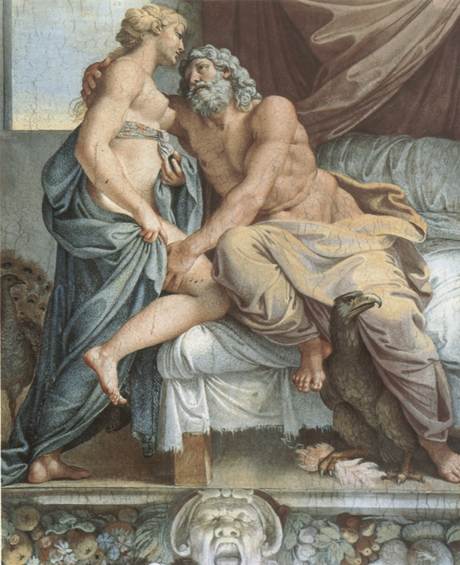
The subsequent comparison of Zeus with a stud in v. 24 is an addition by Rhodoman that cannot be found in Homer’s Iliad. It is obvious that the German poet criticises the god’s sexual desire and extramarital affairs, which are also discussed later in the text, by using this comparison.[6] Zeus’ (physical) “desire” (πόθος, v. 26) is explicitly mentioned again in the text itself. Outside the text, there is a marginal note, Admissario similis Iupiter (“Jupiter is like a stud”), which also picks up on the comparison made. The use of the noun admissarius, which does appear in an agricultural context in ancient literature yet is also used to describe frivolous and immoral people,[7] draws attention to the immoral behaviour of the pagan god. Needless to say, this stands in stark contrast with what is taught in Christianity and how disciples of God are supposed to behave – in the Decalogue itself, two of the Ten Commandments are already directed against adultery and unorthodox desires.[8]
Particularly striking is Rhodoman’s authorial comment, in which the father of the gods is referred to as νήπιος (“the fool”, “the childish one”, v. 27). While in Homer’s Iliad this adjective is only used to describe humans[9] who are considered νήπιοι due to their ignorance of divine intervention, Rhodoman’s commentary reverses the role of Zeus, the almighty father of the gods: he is accused of infantile naivety, which on the one hand allows him to be manipulated by his wife and on the other hand causes him to reveal his extramarital affairs to her. Despite criticism on the authenticity of the Homeric catalogue of Zeus’ love affairs,[10] Rhodoman decided to mention them in his own work. In doing so, he followed the tradition of Christian literature, which often sharply criticises the love affairs of the pagan father of the gods, as is the case, for example, in Prudentius’ work Contra Symmachum (Prud. c. Symm. 1,59–71).[11]
In the context of the Διὸς ἀπάτη scene, however, it is not only Zeus’ behaviour that can be denounced, but also that of Hera: the perfidy with which she unscrupulously misleads her own husband and deceives and bribes Aphrodite and Hypnos in order to implement her plan and to satisfy her personal desires testifies to her malicious and deceitful character. This also contrasts with Protestant marital ethics, according to which a woman should be obedient to her husband.[12]
This brief examination of the text excerpt from the Διὸς ἀπάτη scene has made it clear that Rhodoman, by adding the comparison of Zeus to a stud, his authorial commentary as well as his choice of words (νήπιος) and the reference to Zeus’ extramarital affairs, expresses a criticism of the pagan father of the gods. I have drawn particular attention to Zeus’ lack of castitas and to the fact that his marriage to Hera is not a coniugium pium, which makes the contrast with Protestant ideas of marriage notably clear. For Rhodoman’s readers this means: yes, one should read Homer, but from a critical distance!
Figures:
Figure 1 Unknown Artist, Portrait of Lorenz Rhodoman, 16th century. Source: https://commons.wikimedia.org/wiki/File:Lorenz-Rhodomann.jpg
Figure 2: Annibale Carracci, Jupiter and Juno, 1597, Galleria Farnese, Rome. Source: https://commons.wikimedia.org/wiki/Category:Jupiter_and_Juno_by_Annibale_Carracci#/media/File:Jupiter_and_Juno_-_Annibale_Carracci_-_1597_-_Farnese_Gallery,_Rome.jpg
References:
Bartelink, Gerard Johannes Marinus (1994): Homer, in: Dassmann, Ernst et al. (eds.): Reallexikon für Antike und Christentum. Sachwörterbuch zur Auseinandersetzung des Christentums mit der Antiken Welt. Band 16: Hofzeremoniell – Ianus. Stuttgart, 116–147.
CR = Bretschneider, Karl Gottfried (Bd. 1–15)/Bindseil, Heinrich Ernst (Bd. 16–28) (eds.) (1834–1860): Corpus Reformatorum. Philippi Melanthonis opera quae supersunt omnia. Vol. 1–28. Halle/Braunschweig.
Gärtner, Thomas (ed.) (2024): Widmungsgedicht zur Ausgabe von Dions Trojarede (= Rhod. Dion.praef.), https://www.rhodomanologia.de/html/rhod-dion-praef.html.
Krieter-Spiro, Martha/Bierl, Anton/Latacz, Joachim (eds.) (2015): Homers Ilias. Gesamtkommentar (Basler Kommentar/BK). Band X: 14. Gesang. Faszikel 2: Kommentar. Berlin/Boston.
Ludwig, Walther (2008): Eine protestantische Ehelehre – die Sammlung der Carmina et Epistolae de coniugio ad D. Davidem Chytraeum (1562), in: Ludwig, Walther/Steiner-Weber, Astrid (eds.): Supplementa Neolatina. Ausgewählte Aufsätze 2003–2008. Hildesheim/Zürich/New York, 185–215.
Murray, August Taber (ed.) (1925): Homer, The Iliad II. With an English translation by A. T. Murray. Cambridge.
Snell, Bruno et al. (eds.) (2004): Lexikon des frühgriechischen Epos. Band 3: M–P. Göttingen.
Weise, Stefan (ed.) (2023): Arion (= Rhod. Arion), https://www.rhodomanologia.de/html/rhod-arion.html.
Weise, Stefan (2025a): Rhodoman’s Odyssey – Between Admiration, Alienation and Appropriation, in: Weise, Stefan (ed.): Griechischhumanismus des 16. Jahrhunderts. Lorenz Rhodoman im Kontext und digital. Stuttgart, 325–340.
Weise, Stefan (ed.) (2025b): Ilias parva (1604), Teil I: Griechisch-lateinische Periochen zu den 24 Büchern von Homers Ilias (= Rhod. Il.parv.Hom. 1–24), http://www.rhodomanologia.de/html/rhod-il-parv-hom-1-24.html.
Weise, Stefan (2025c): Mythos und Evangelium. Studien zu den mythologischen Gedichten Argonautica, Thebaica und Troica von Lorenz Rhodoman (nebst Edition des griechischen bzw. griechisch-lateinischen Textes und deutscher Übersetzung). Im Januar 2025 an der Bergischen Universität Wuppertal eingereichte Habilitationsschrift.
West, Martin (ed.) (2000): Homeri Ilias. Recensuit et testimonia congessit Martin L. West. Volumen alterum rhapsodias XIII-XXIV et indicem nominum continens. Monachii et Lipsiae.
Footnotes
[1] The Greek text and its translation are cited from Gärtner 2024.
[2] See CR XI, 397–413. On the benefits of reading Homer, see in particular 400–404. For a comparison of Rhodoman’s image of Homer and Melanchthon’s Praefatio in Homerum, see Weise 2025a, 337f.
[3] The Greek text and its translation are cited from Weise 2025b.
[4] Hom. Il. 14,294: ὡς δ’ ἴδεν, ὥς μιν ἔρος πυκινὰς φρένας ἀμφεκάλυψεν (“And when he beheld her, then love encompassed his wise heart about”, translation by Murray 1925). Cf. the apparatus in Weise 2025b on Rhod. Il.parv.Hom. 14,23f.
[5] The Greek text and its translation are cited from Weise 2023.
[6] In this context, Weise draws attention to the criticism of Zeus’ sexual desire expressed in Rhodomans’ Troica (Rhod. Tro..2 102‒110), cf. Weise 2025b, note 33 on Rhod. Il.parv.Hom. 14,26. In another work, he also provides an overview of the central role of “libido and adultery” in Rhodoman’s mythological works, see Weise 2025c, 63f.
[7] For the use of the noun in an agricultural context, see, for example, Varro rust. 2,7,1, Colum. 6,27,3 et al. and Plin. nat. 28,217; for its use in a pejorative sense, see, for example, Cic. Pis. 69, Plaut. Mil. 1112, Sen. nat. 1,16,2 and Anth. R. 149,9.
[8] See Ex 20,14: “Thou shalt not commit adultery” and Ex 20,17: “Thou shalt not covet thy neighbour’s wife”.
[9] Only in Hom. Il. 15,104 does Hera once refer to herself and the other gods (except Zeus!) as νήπιοι. The Lexikon des frühgriechischen Epos lists only two other instances in which gods are described with this adjective: in the Homeric hymn h.Merc. 406, Apollo describes his half-brother Hermes as νήπιος, and in h.Ven. 223, Eos is called νηπίη because she asked Zeus to grant immortality to the mortal Tithonos, but not youth.
[10] Even in ancient times, this catalogue of women was sometimes rejected, for example by Aristophanes of Byzantium, see Krieter-Spiro et al. 2015, 145.
[11] Bartelink’s article in the Reallexikon für Antike und Christentum also provides an overview of Christian criticism of Homer, see Bartelink 1994, 116–147.
[12] This view is probably based on the Bible passage Eph 22–33, which appears to be the “biblische Kernstelle zur christlichen Ehe” (Ludwig 2008, 194). However, Ludwig 2008, 189–195 points out that the interpretations of this passage could differ considerably. The description of Hera as uxor imperiosa (“imperious wife”), which can be found in a marginal note to Il.parv.Hom. 1,28–30 and in the text itself in Il.parv.Hom. 16,29, also emphasizes that the goddess is sometimes imperious and not always submissive to her husband.
How to cite
Lelittka, Karen. 2026. “Zeus, the fool? Criticizing the pagan father of the gods in Lorenz Rhodoman’s Ilias parva (1588/1604)” Hermes: Platform for Early Modern Hellenism (blog). 1 April 2026.
Deposit in Knowledge Commons: https://doi.org/10.17613/65xhf-chs29
 Hermes

