Riccardo Stigliano (Universität Innsbruck)
Should the last Byzantine historian be considered an early modern Hellenist? Yes, because he lived through the crucial years of the fall of Constantinople. After all, he started writing as soon as Constantinople fell, which was at the very beginning of the Modern Age. Yes, if we consider the literary genre with which he engaged and the classical spirit with which he approached it. Indeed, yes, if we take into account not only the chronology of his work, but also the cultural climate in which he operated.
Laonikos Chalkokondyles, also known as Nikolaos Chalkokondyles, stands as one of the principal chroniclers of the fall of Constantinople. His ten-book work, Demonstrationes historiarum (Ἀποδείξεις Ἱστοριῶν), covers the period from 1298 to 1463, and offers a profound historical account that reaches beyond a simple chronological narration. Although primarily known for his account of the demise of the Byzantine Empire, his historiographical approach offers insights into the rise, expansion, and consolidation of the Ottoman Empire, which he presents as a major force in the formation of European modernity.
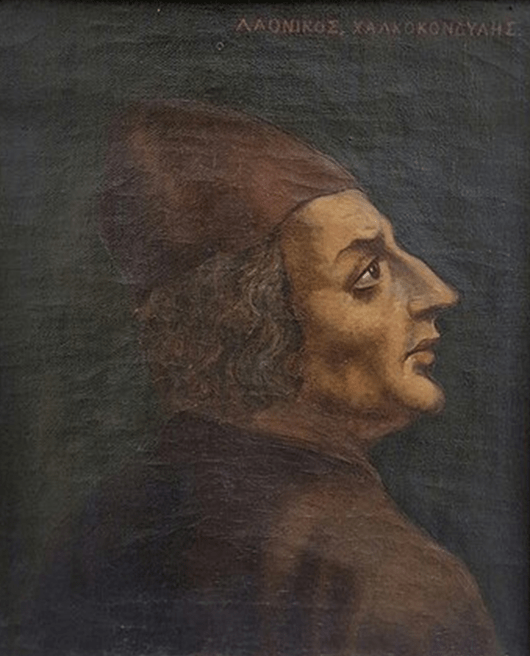
Chalkokondyles was born into an aristocratic family with close ties to the Florentine Acciaiuoli family, who controlled the Morea during the final years of the Byzantine Empire. His familial connections placed him at the intersection of Byzantine decline and the rising Ottoman power. It is in this context that Chalkokondyles’ work emerges not merely as a chronicle of events but as a critical analysis of the changing political and cultural landscape of the Eastern Mediterranean.
A chronicle not of Byzantine demise but of Ottoman expansion
Chalkokondyles’ Demonstrationes historiarum is not simply a detailed account of the fall of Constantinople but a broader investigation into the history of the Ottoman Empire and its impact on the Byzantine world. On the one hand, stylistically, Chalkokondyles draws on the prose of Thucydides. On the other hand, his narrative approach and content clearly echo Herodotus. In fact, his work blends historiography with ethnography, offering a nuanced examination of the peoples and cultures that shaped the Empire. In this sense, Laonikos transcends the role of a mere chronicler of Byzantine decline. Instead, he assumes the role of an investigator (the first meaning of the term ἱστορία), delving into the rise and consolidation of the Ottomans as they supplanted the Byzantine Empire.
Like a new Herodotus, his approach to the Ottoman Empire is particularly noteworthy: while many of his contemporaries and successors focused on the fall of Constantinople as the defining moment of Byzantine – and European – history, Chalkokondyles frames the Ottomans not merely as an external threat but as a dynamic force in the development of continental modern history. His history of the Ottomans is not limited to military conquests but extends to cultural exchanges and the interactions between different peoples under Ottoman rule. This approach broadens the scope of his narrative, presenting the Ottomans as a complex and multifaceted entity, and underscores Laonikos’ understanding of his Empire’s transformation into a new socio-political order.
The Herodotean legacy
While some have rightfully called him the “Thucydides of Greek Humanism”, it is crucial to emphasize one important methodological aspect of his work: his adherence to a Herodotean principle of impartiality. Although Chalkokondyles is not always the most reliable historian, he does strive for a balanced perspective in his judgments. His history is marked by an attempt to understand the motivations behind the rise of the Ottomans, rather than merely recording events as they happened. This intellectual curiosity reflects the classical tradition of seeking not just to record history but to understand its causes and consequences. By framing his work as both an ethnographic and historical investigation, Laonikos echoes the methods of both Herodotus and Thucydides, blending narrative with analysis in a way that was ‘novel’ for his time (at the end of the Middle Ages), but at the same time ‘traditional,’ since it was the ancient method of history writing. In this respect, Chalkokondyles is truly a humanist, reasonably an early modern Hellenist.
The reception of his work
Often confused with his more famous cousin Demetrios Chalkokondyles and frequently compared to his contemporaries (the last Byzantine historians and chroniclers), Laonikos remains largely unknown, both within the field of late Byzantine literature and in the realm of humanist literature, which was primarily produced in the West and in Latin. The question of where Laonikos wrote his history is a subject of scholarly debate, as is even his own name! The traditional view holds that he composed it either in exile in Crete or in Italy shortly after the conquest of Constantinople. However, a recent hypothesis by Anthony Kaldellis suggests it was authored in Constantinople at the very heart of the Ottoman court. Thus, Laonikos’ legacy is further complicated by the dual identities preserved in tradition: Laonico Calco(co)ndila (his Italianized name) and Nikolaos (his Greek name). The Demonstrationes historiarum were predominantly read in a Latin translation (1556) by Konrad Klauser, whose version was so faithful to the original that it did not Latinize the Greek names or render them in a Western style. This translation became the standard for scholars studying the Ottoman expansion, and even major orientalist works, such as Joseph von Hammer-Purgstall’s History of the Ottoman Empire (1827–1835), relied on Klauser’s Latin text, not the Greek original.
As mentioned above, it is unclear whether Chalkokondyles wrote his work in the remaining Venetian territories in Greece or in Constantinople, as some scholars, such as Kaldellis, have suggested. Nevertheless, it is notable that, of the four leading historians of the fall of Byzantium, Chalkokondyles has received comparatively little attention, particularly in the West. This is largely due to the challenging style and language of his writing. In Italy, for instance, Laonikos’ presence is largely a historiographical reconstruction based on the fact that his cousin Demetrios resided on the Italian peninsula. Nevertheless, Chalkokondyles’ work remains essential for understanding the fall of the Byzantine Empire and the rise of the Ottoman Empire.
A historical vision in transition
Chalkokondyles’ work can be considered as a bridge between the classical tradition of Greek historiography and the early modern understanding of the Ottoman Empire. His treatment of the Ottomans as both a political and cultural entity, rather than simply a military conqueror, reflects the beginning of a new intellectual perspective, one that recognizes the complexity of history and the interplay of different civilizations.

Moreover, his examination of the Ottoman state reflects the intellectual climate of the time. Whether Laonikos composed his Demonstrations of History in Italy is debatable. Instead, Laonikos seems to have observed the new Ottoman masters of Constantinople from the city itself rather than as an exile observing from afar. This is reflected in the paradoxical ideological efforts of his mentor, Georgios Gemistos Plethon, to create a new ethnic identity for the fatigued and exhausted Eastern Roman Empire. The idea of Romanitas and Rome, though transformed into “Romanism” and transplanted to the “New Rome,” no longer functioned after the atrocities of the Fourth Crusade and the Latin occupation of the Empire. Plethon, under whose tutelage Laonikos studied, proposed a new, Platonically pagan national identity rooted in elements that had predated foreign conquests, long before the creation of Greco-Roman classical culture. In essence, one should look at Greek classical identity alone.
Thus, despite these efforts – which are perhaps more of a temptation than a certainty – Laonikos remained open to the possibility of viewing the Ottomans not just as conquerors, but also as an alternative embodiment of Greek identity. On the one hand, the Latins, also known as the Franks, claimed the Eastern territories in the name of a long-dead Roman Empire (the Fourth Crusade). In contrast, the Ottomans maintained a state apparatus that incorporated various peoples, religions and languages. One vision sought to impose order under the dominance of Latinity and Roman rites, while the other offered an administration uninterested in the Eastern schism and the language of the conquered people, and more focused on their territories.
It is worth noting that these were the same Ottomans against whom the Greeks would later wage a war of liberation, and that they had no particular interest in converting the Greek population to Islam. However, it appears that Laonikos studied the origin, expansion and state organisation of the Ottomans from the walls of Constantinople in order to understand what his people might expect under their new rule. In other words, he wondered whether the Greeks would still be permitted to remain Greek at the beginning of a new era.
Conclusion
This “Herodotus of Byzantium”, the last Byzantine historian, can no longer be confused with the homonymous academic historian from Milan. He should not be considered merely a chronicler of the fall of Constantinople, nor an inaccurate continuator of his predecessor’s chronicles. Ultimately, Laonikos deserves to be recognised as an investigative historian in his own right. Otherwise, we risk making further mistakes about his role in the final stages of Byzantine historiography and the early years of the Ottoman Empire.
Figures
- Figure 1. Early modern painting of Laonikos Chalkokondyles National Historical Museum of Greece.
Source: https://www.librairieclavreuil.com/en/chalcondyle-laonicus-histoire-general-des-turcs-contenant-lhistoire-de-chalcondyle-traduite-par-blaise-de-vigenaire-avec-les-illustrations-du-meme-auteur-et-continuee-jusques-en-lan-m-d-c-xii/ - Figure 2. Map of Constantinople in the 1662 French translation of Chalkokondyles’ Demonstrations of History.
Source: https://en.wikipedia.org/wiki/Laonikos_Chalkokondyles#/media/File:Laonikos_Chalkokondylis.JPG
References
- Kaldellis, Anthony. “The Date of Laonikos Chalkokondyles’ Histories.” Greek, Roman, and Byzantine Studies 52 (2012) 111–136.
- Kaldellis, Anthony: “The Interpolations in the Histories of Laonikos Chalkokondyles.” Greek, Roman, and Byzantine Studies 52 (2012) 259–283.
- Kaldellis, Anthony. “The Greek Sources of Laonikos Chalkokondyles’ Histories.” Greek, Roman, and Byzantine Studies 52 (2012) 738–765.
- Kaldellis, Anthony. Laonikos Chalkokondyles, The Histories, 2 vols. Cambridge: MA/London, 2014 (English translation).
How to cite
Stigliano, Riccardo. 2025. “Laonikos Chalkokondyles: The Last Byzantine Historian and the Dawn of Ottoman Historiography.” Hermes: Platform for Early Modern Hellenism (blog). 1 October 2025.
Deposit in Knowledge Commons: https://doi.org/10.17613/v1vec-88257
 Hermes
