Elena Maria Cassol (Università Ca’ Foscari Venice)
On 13 May 1572, Ugo Boncompagni was elected Pope with the name Gregory XIII and his heraldic dragon would come to dominate the cultural and political landscape for the next thirteen years. Meanwhile, somewhere in Northern Italy, Tito Prospero Martinengo was waiting for the storm to pass. Only a year earlier, on 14 February 1571, he had been put on trial for heresy as a follower of the radical doctrines of Giorgio Siculo (Prosperi 2000). Yet, ten years later, a collection of Greek poems signed by Tito Prospero Martinengo would be published in Rome, featuring the papal coat of arms on its frontispiece. How could a man marked by such a dangerous spiritual past find his way back into the graces of the Roman establishment? The answer, perhaps, lies in the ancient language of the Greeks.
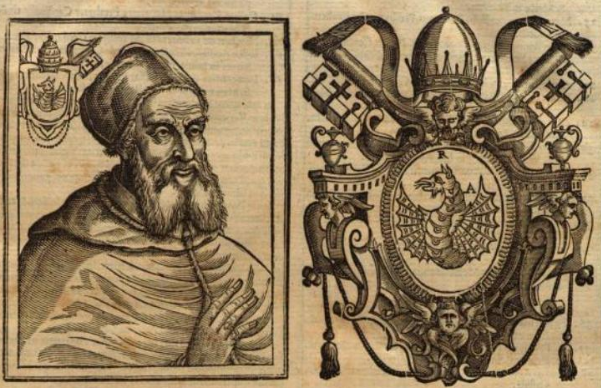
During the 16th century, Italy’s role shifted from being the heart of Hellenic studies to its periphery. The Protestant Reformation had triggered a decisive translatio studiorum toward the North, turning the study of Greek into a core element of its own identity, a vital tool for an autonomous interpretation of the Scriptures. Conversely, this same issue sparked anxiety within the post-Tridentine Church, which progressively marginalized Greek studies. An attempt to reverse this trend was made by Gregory XIII. He sought to bridge the gap with the Greek Eastern Church as an anti-Protestant strategy, founding the Greek College of Saint Athanasius in 1576 and actively promoting the publication of Greek works focused on Christian themes. The shift toward a Philhellenic policy was driven by influential figures within the Curia, most notably Cardinals Antonio Carafa and Guglielmo Sirleto. Both were acquainted with Tito Prospero Martinengo, a Benedictine monk from Brescia belonging to the Cassinese Congregation, a monastic branch of the Benedictine Order founded by Ludovico Barbo at the Abbey of Santa Giustina in Padua in 1504.
Martinengo, who had been put on trial for heresy in 1571, possessed a great command of the Greek language, a skill that the Church found too valuable to ignore. His philological expertise was harnessed for several editions of Christian texts. Specifically, Cardinal Carafa sought Martinengo’s help to resolve textual issues for the Sixtine Septuagint (1586). Two letters preserved in the Vatican Library (ms. Vat. lat. 9064, ff. 198-200), dated 20 June and 28 July 1579, stand as witnesses to Martinengo’s direct involvement in this monumental edition. It is therefore likely that Martinengo was progressively rehabilitated within the ecclesiastical hierarchy precisely through the mediation of figures like Sirleto and Carafa, and thanks to his mastery of Greek.
This rehabilitation bore fruit during the 1580s, when Martinengo published his works with Francesco Zanetti, the official printer of the Roman Curia. His first major work, the Ποιήματα διάφορα Ἑλληνικὰ καὶ Λατινικά (Poiemata diaphora Hellenika kai Latinika, 1582), stands as a rare exception in the Italian literary landscape of the time. It represents one of the very few collections of Greek poetry produced in Italy since Poliziano’s Liber epigrammatum Graecorum, and it remains the only collection of Greek sacred poetry from the Italian Renaissance.
As we can see in Figure 2, the title page of the Poiemata displays the coat of arms of Gregory XIII. The collection exhibits a remarkable variety of both meter and content; it includes long hexameter compositions dedicated to Christ, Pindaric odes for the Virgin Mary, and hymns for the Saints, alongside encomiastic poems addressed to personal acquaintances, high-ranking Cardinals, and Pope Gregory XIII himself.
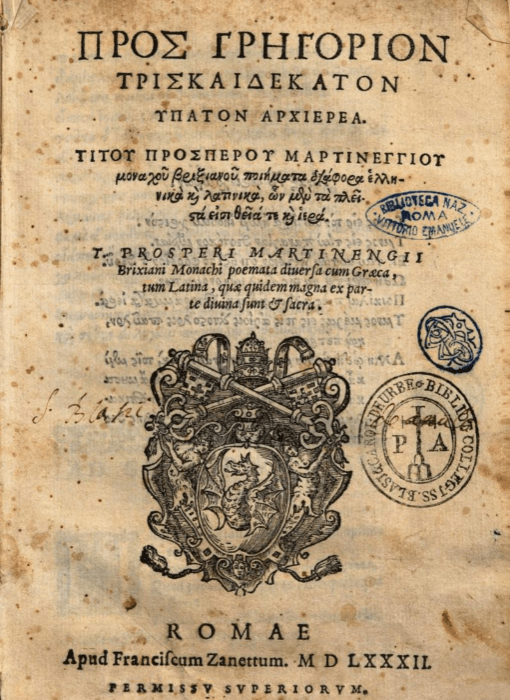
Given the sacred subject matter of the work, the prominent ecclesiastical figures mentioned within it, the choice of the printer, and the presence of the papal coat of arms, it is not difficult to hypothesize that Martinengo and his work were somehow integrated into the Church’s cultural policy of those years. Adopting this interpretive framework, Martinengo’s work represents a successful, yet isolated, expression of the Philhellenic milieu of the Roman Church during those years (Pontani 2025: 44-49).
In this context, the poem dedicated to Guglielmo Sirleto, composed in iambic trimeters and serving as both an encomium and a programmatic manifesto of the Poiemata, deserves particular attention. The composition is divided into two parts. In the first verses, Martinengo celebrates Sirleto’s dual greatness: the Cardinal’s institutional power and his intellectual authority, which makes him a “sparkling star of illustrious knowledge” (ἄστρον φαεινὸν εὐκλεῶν μαθημάτων; Martinengo 1582: 7, v. 2).
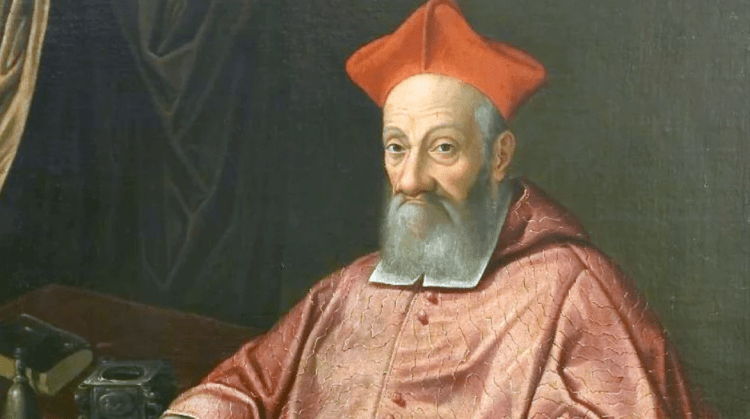
Cardinal Sirleto, depicted in Figure 3, was indeed a key individual in Counter-Reformation culture, engaged in the editing of texts, the fight against heresies, and the revision of the Index of Prohibited Books (Fragnito 2018). Born in Calabria, he soon moved to Rome, where his philological competence attracted the attention of Cardinal Marcello Cervini, who sought him out as a collaborator in his editorial ventures for the recovery of patristic texts. His profound knowledge of Greek and his burgeoning mastery of Hebrew made him a valuable consultant during the Council of Trent, providing Cervini and other legates with translations and research on crucial doctrinal themes. At the same time, he was entrusted with the reorganization and enrichment of the Vatican Library’s holdings, consolidating his reputation as a trusted scholar of the Curia. His skills were fully applied under Gregory XIII, who tasked him with preparing numerous sacred works for print – including a Roman edition of the Vulgate – and deepening dialogue with the Greek Church. In addition to his cultural commitment, Sirleto was involved in implementing censorship and revising the Tridentine Index. Martinengo not only collaborated on that great cultural project in which Sirleto was also engaged (for example, by participating in the edition of the Septuagint, whose commission was appointed by the Cardinal himself), but also had the opportunity to get to know him personally in 1569, through the mediation of the Archbishop of Cesena, Odoardo Gualandi.[1] As further confirmation of the relationship between Martinengo and the Cardinal, several of Martinengo’s poems appear in Vat. gr. 1902, a miscellaneous manuscript that can be primarily attributed to Guglielmo Sirleto (Maronese 2025: 121).
The second part of Martinengo’s Greek composition outlines the poetic project of the entire collection, whose themes Martinengo announces: God, the Virgin, Saints Peter and Paul, and the ensemble of κομψὰ μελύδρια (“refined little songs”; Martinengo 1582: 7, v. 13). This planning, typical of classical proems, confirms the function of the poem as a manifesto of the work. The ideological goal is forcefully declared in the final verses (19-25):
Ἢν δ’ αὖτ’ ὀρέξῃ μοι θεὸς μᾶκος βίου,
φόρμιγγα Πινδάρειον αἰόλον κροτεῖν
οὐκ ἐκλίποιμι, καὶ κρατίστην μητέρα
μολπαῖσι δώσω, καὶ καλαῖς Μουσῶν ῥοαῖς
Σωτῆρά τ’ ἀνδρῶν τῆσδ’ ὑπέρτατον γόνον
ἡμῶν πινύσσων Αὔσονας θεῖα θροεῖν
μύθους λιπόντας, καὶ βέβηλ’ ἀείσματα.
And if God, in turn, shall grant me a long life,
to make the variegated Pindaric lyre resound,
may I not cease, and the most powerful Mother
I will offer to the songs, and to the beautiful flows of the Muses
the Savior of men, her supreme descendant,
and I will inspire the Ausonians to chant aloud our sacred verses,
having abandoned profane myths and songs.
The poetic architecture of these final verses, particularly the chiasmus spanning lines 21-23, highlights Martinengo’s commitment to celebrate in poetry the “most powerful Mother” and her son, the “Savior of men”. Martinengo professes the will to employ a classical formal apparatus, clearly highlighted by a series of references (φόρμιγγα, Πινδάρειον, καλαῖς Μουσῶν ῥοαῖς), not to celebrate ancient myths, but to raise hymns to God and the Virgin, definitively abandoning “profane songs (βέβηλ’ ἀείσματα)”. This transition is evident in the poem itself, which is woven with refined classical echoes. Martinengo constructs his imagery using a sophisticated mosaic of ancient sources: he borrows the “Pindaric lyre” (φόρμιγγα πινδάρειον) from Nonnus’ Dionysiaca (25.21) and the “flows of the Muses” (Μουσῶν ῥοαῖς) from Pindar himself (Nemean Odes 7.12). By furthermore utilizing Homeric, Euripidean, and Callimachean vocabulary, Martinengo demonstrates that the very language of the “profane” past could be stripped of their mythological charge and reinvested with sacred meaning. This goal does not only have a personal dimension but is announced as a true large-scale cultural project. Martinengo states, in fact, that he wishes to “inspire the Ausonians [the Italians] to chant aloud our sacred verses” (v. 24).
Martinengo’s story remains, in many ways, an open question. A monk tried for heresy who resurfaces years later as a collaborator in the Church’s editorial efforts during the Counter-Reformation; a poet who writes in Ancient Greek at a time when few in Italy still did; a figure who moves, perhaps strategically, perhaps sincerely, between the margins and the centre of Roman cultural life. The Poiemata may well represent the fruit of this difficult navigation: a collection that speaks the language of Pindar and Homer yet places that language in the service of Christ and the Virgin.
Whether Martinengo’s rehabilitation was the result of deliberate patronage, personal ambition, or genuine devotion – or some combination of all three – is difficult to say with certainty. What seems clear is that his command of Greek opened doors that his past might otherwise have kept shut. In the Philhellenic climate fostered by Gregory XIII, a “Pindaric lyre” tuned to sacred themes was not merely a literary curiosity; it was, potentially, a cultural and ecclesiastical asset.
His work was not without recognition among his contemporaries – Torquato Tasso himself wrote a sonnet in his honour – yet his ambition to inspire the Italians to sing divine songs in Greek found no followers. His work stands, for now, as a singular experiment at the intersection of classical learning and religious pressure.
Figures
- Figure 1. Portrait of Gregory XIII with his heraldic coat of arms. Source: Chacón, Alfonso. Vitae et res gestae Pontificum Romanorum et S.R.E. Cardinalium. Tomus Quartus. Romae: Philippus et Antonius de Rubeis, 1677, p. 1.
- Figure 2. Title page of the Poiemata diaphora (1582)
- Figure 3. Portrait of Guglielmo Sirleto by Iacopino del Conte, private collection
References
- Fragnito, Gigliola. 2018. “Sirleto, Guglielmo.” Dizionario Biografico degli Italiani, vol. 71. Roma: Istituto della Enciclopedia Italiana.
- Maronese, Manoel. 2025. Graeca in angulo Venetorum. La produzione poetica in greco antico nel Veneto di XVI secolo. Alessandria: Edizioni dell’Orso.
- Martinengo, Tito Prospero. 1582. Ποιήματα διάφορα Ἑλληνικὰ καὶ Λατινικά. Roma: Francesco Zanetti.
- Pontani, Filippomaria. 2025. “Su nel ciel altro Elicona: Versifying the life of Christ on either side of the Alps”. In Griechischhumanismus des 16. Jahrhunderts. Lorenz Rhodoman im Kontext und digital, edited by Stefan Weise. Stuttgart: Franz Steiner Verlag.
- Prosperi, Adriano. 2000. L’eresia del Libro Grande. Storia di Giorgio Siculo e della sua setta. Milano: Feltrinelli.
Footnotes
[1] Cf. ms. Vat. lat. 6190/1, f. 130r (Pontani 2025: 44).
How to cite
Cassol, Elena Maria. 2026. “A “Pindaric Lyre” under the Dragon’s Wing: Tito Prospero Martinengo’s Greek Poetry” Hermes: Platform for Early Modern Hellenism (blog). 1 June 2026.
Deposit in Knowledge Commons: https://doi.org/10.17613/wcnwr-efj94
 Hermes