Στεναγμοὶ τῶν ναυτῶν: Traveling from France to Greece in the 1830s

Lev Shadrin (Universität Innsbruck)
<...> καὶ τὸ πνεῦμα, καίπερ μαλακὸν ὂν, ὤθησεν ἡμᾶς πρὸς Ἄνδρον. 
Στεναγμοὶ τῶν ναυτῶν.
“<…> and the wind, as gentle as it was, pushed us towards the Andros island.
Sailors groan.”
GSA 108/2922, Goethe- und Schiller-Archiv Weimar, f.51v

In 1837, Karl Benedikt Hase, a Franco-German Hellenist working in Paris, made a two-month long trip to Greece. His primary destination was Athens, where Hase planned to meet with his colleagues and attend lectures at the newly established University of Athens.

The only information about this trip comes from Hase’s private diary, which he has kept throughout his life, diligently recording daily events, meetings, dinners, and private affairs in an eclectic fusion of Ancient Greek interspersed with Modern Greek vocabulary and French transliterations.

Let’s take a glimpse at the passages describing Hase’s adventures across the Mediterranean and the Aegean seas and see what it was like to travel to Greece in the early 19th century.

Charting the course

The diary pages span the hot summer months of June and July 1837 and read very much like a travelogue, in contrast to the regular daily entries. The changes are evident in the content and narrative structure, vocabulary and syntax, and can even be noticed in Hase’s writing.

Taken out of his daily routine of editing manuscript catalogues for the Bibliothèque Royale, teaching Greek at the École Polytechnique, and moving around the same dozen places in Paris, Hase leaped at the opportunity to scrupulously record every step of the journey. Each travel day in the diary is bespeckled with toponyms, which have been diligently transcribed, transliterated or translated into Greek, supplied with necessary diacritics, and properly declined.

These named entities present the diary reader (and transcriber) with a collection of linguistic puzzles, some of which are quite easy to solve, e.g. Προβιγκία1 for the French region of Provence or Ἔλβα νῆσος for the island of Elba. In other cases, Hase refers to the ancient names of the cities, for instance, Μασσαλία for Marseille, Λούγδουνον for Lyon, or Νεαπόλης for Naples. Solving these toponymic riddles to correctly identify each location required consulting secondary sources, including 19th-century maps.

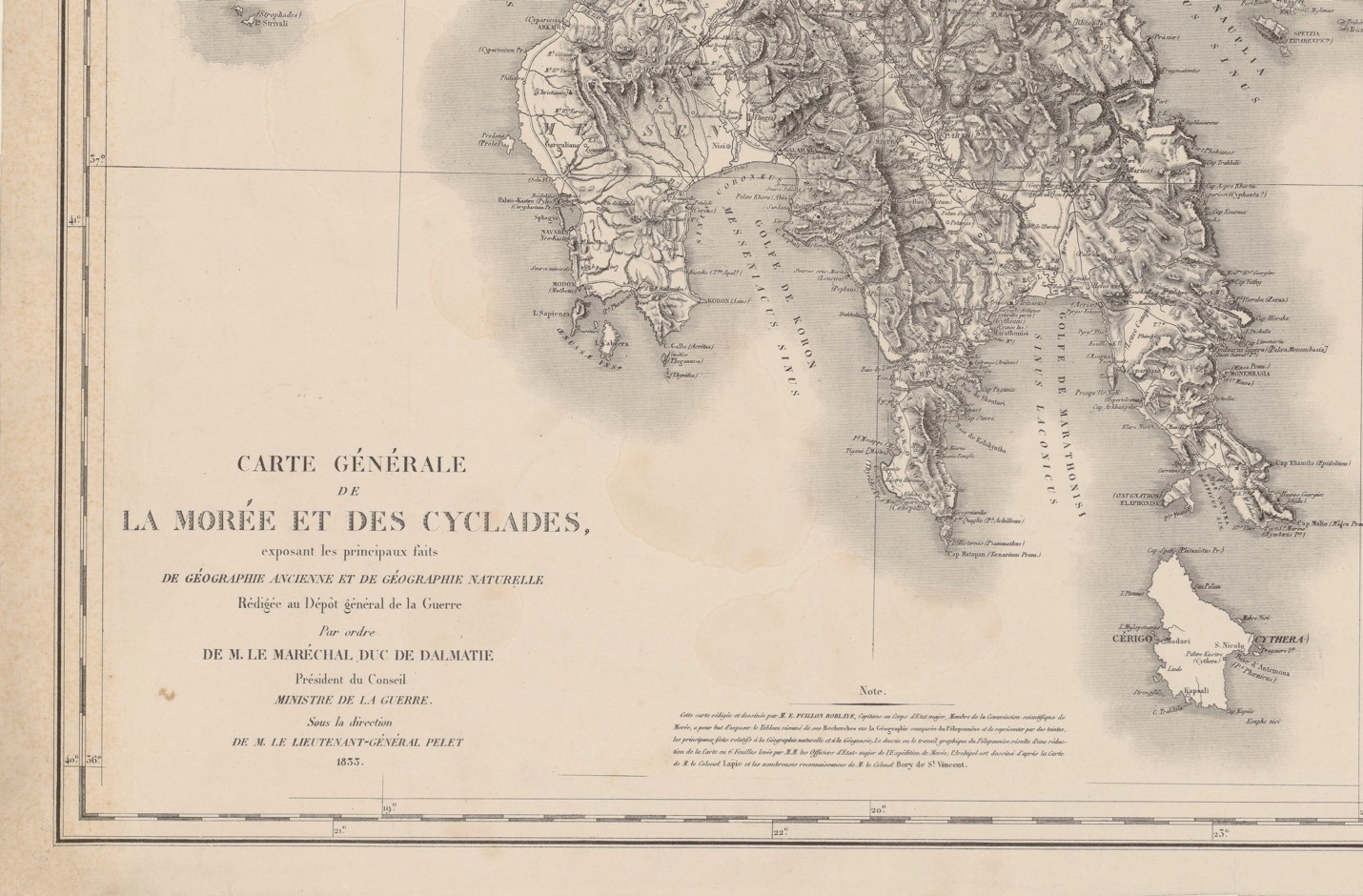
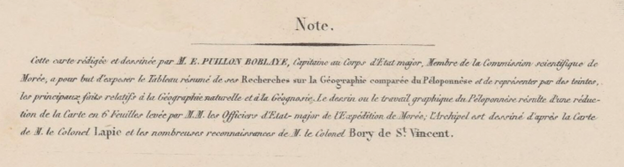
Hase is well known for his editorial contributions to, among other works, cartography charters – in previous diary entries he mentioned French cartographers Pierre Lapie and Émile Le Puillon de Boblaye, who had commissioned Hase to verify and append the Greek toponyms for their maps. On May 31, a couple of days before departing for Greece, Hase noted down a list of items packed away in his travel bag, which includes inter alia a map of the Cyclades by Boblaye.

“I have in my bag: 
1. maps of the Rhône river
2. (maps) of the Peloponnese
3. a map of the Cyclades, by Boblaye”

An excerpt from the diary volume of 1837 (GSA 108/2922, f.46r)

One of Boblaye’s maps, La carte générale de la Morée et des Cyclades of 1833, is preserved at the Bibliothèque National de France. It features in detail the Peloponnese region along with the numerous Aegean islands and names of towns, villages, and islands. It is very likely that Hase had indeed packed a copy of this πίναξ τοῦ βωβλαῖε for the trip. Certain toponyms mentioned in the diary presented quite a challenge for identification at first. However, they align perfectly with the names of islands and cities featured on the map, which often contain both contemporary and ancient names:

K.B. Hase, diary of 1837É. Boblaye, map of 1833Modern Greek name
ἡ νῆσος τοῦ Ἁγίου Γεωργίου τοῦ Δένδρου / Ἅγιος Γεώργιος δ’ ἈρβώρανSt. Georges d’ArboraΆγιος Γεώργιος Ύδρας
ΓαϊδουρονῆσιGaïdero-Nisi (Patrocli Vallum)Πάτροκλος (Γαϊδουρονήσι)
τὸ ἀκρωτήριον ΜαλείανCap Malio (Malea Prom.)Ακρωτήριον Μαλέας
ΖέαZea (Ceos)Κέα (Τζία, Κέως)
ΘερμιάThermia (Cythnus)Κύθνος 

After carefully transcribing the toponyms and identifying the names, I was able to put together a map of Hase’s travels. Since the road network of France has evolved quite significantly over the past 200 years, the lines connecting the nodes are quite arbitrary and serve as a general guide rather than an accurate route. The sea is even worse – there are no roads altogether, therefore I had to rely solely on the sequence of toponyms in the text, as well as occasional directions (e.g. “to the left we saw…”).

Coaches, boats, and ἀτμόπλοια

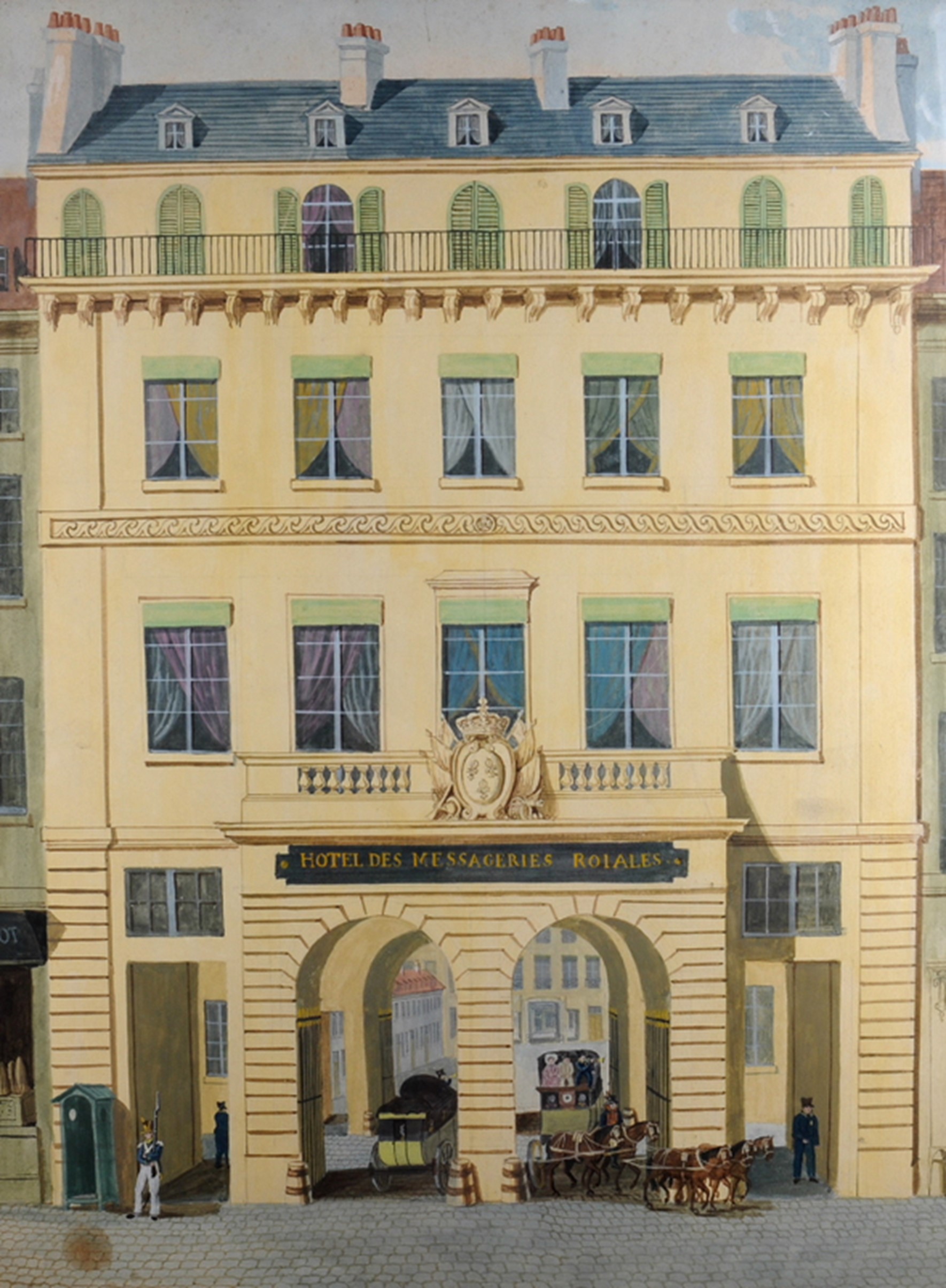
In today’s day and age, it is easy to overlook the troubles and perils of long-distance travels in the 19th century. Hase had to use several means of transportation, endure the tumultuous and unpredictable seas, and was even faced with a plague outbreak throughout his journey. He left Paris on June 4 in a stagecoach of Messageries Royales, a diligence company that provided postal and transportation services. After an emotional farewell with his maid Louise (χωρισμὸς ἐν κλαυθμῷ καὶ ξὺν ἡδίστῃ εὐδία, “departure in tears and in most pleasant weather”), Hase set off from the Hôtel des Messageries at rue Notre-Dame-des-Victoires (Παναγίᾳ τῶν Νικῶν).

<…> ἐδράμομεν εἰς τὰς καλουμένας Μεσσαγερίες Ῥοϊάλες, Παναγίᾳ τῶν Νικῶν <…>
<…> we rushed to the so-called Messageries Royales, at rue Notre-Dame-des-Victoires <…>

GSA 108/2922, f.47r
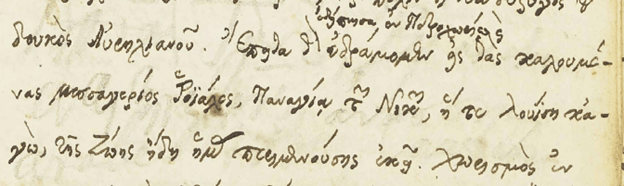
The stagecoach often traveled during the night (νυκτοπορία), but Hase was able to enjoy certain comforts, like breakfasts in hotels, spontaneous purchases (ἠγόρασα σειρῆτι ἔρυθρον καὶ φουλάρδιον, “I bought a red ribbon and a scarf”), and even an occasional coffee along the way (ἔπιον ἐκεῖ καφέ). In Lyon, Hase boarded a boat, which took him further south to Avignon, where he continued onwards to Marseille in a coupé carriage, μεταξὺ ἐμπόρου τινὸς ῥετιρὲ <…> καὶ νέου ἐμπόρου κωμμὶς βοιαγεῦρ, “between some retired merchant <…> and a young commis-voyageur.”
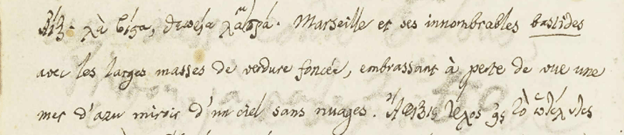
“Marseille et ses innombrables bastides avec les larges masses de verdure foncée, embrassant à perte de vue une mer d'azur miroir d'un ciel sans nuages.”
"Marseille and its countless bastides, with their broad masses of dark greenery, embracing as far as the eye can see an azure sea, mirror of a cloudless sky.”

GSA 108/2922, f.48v

Transliteration and code-switching are very frequent devices in Hase’s diary. Not only did he transcribe toponyms and neologisms into Greek, but on rare occasions he switched to French (like in the description of Marseille, shown in the picture above), German, or Latin to better convey his ideas.

In Marseille, Hase boarded a steamboat (the Modern Greek τὸ ἀτμόπλοιον almost looks out of place among all the classical Greek!), which carried him further into the Mediterranean – and to an inevitable stop on the island of Malta, which was at the time, unbeknownst to the travelers, ravaged by plague. This part of the journey, however, deserves a separate post!


The nine surviving volumes of Hase’s ‘Secret Diary’ form the core of the LAGOOS project, hosted at the University of Innsbruck and funded by the Austrian Science Fund (FWF) [Y 1519-G], Grant DOI 10.55776/Y1519. The project, which I am very happy to be a part of, seeks to make the diary available to scholarship for the first time in a digital edition.

Follow our website for updates on the life of the 19th century scholar as we flip the diary pages! We also have a separate website for the digital edition, where the first volume (1825) has recently been published.


Footnotes
  1. All quotations from the diary are provided in a semi-diplomatic transcription, which maintains Hase’s orthography. ↩︎

Pictures

How to cite

Shadrin, Lev. 2025. “Στεναγμοὶ τῶν ναυτῶν: Traveling from France to Greece in the 1830s.” Hermes: Platform for Early Modern Hellenism (blog). 1 April 2025.

Deposit in Knowledge Commons: https://doi.org/10.17613/9e6ap-x6r42
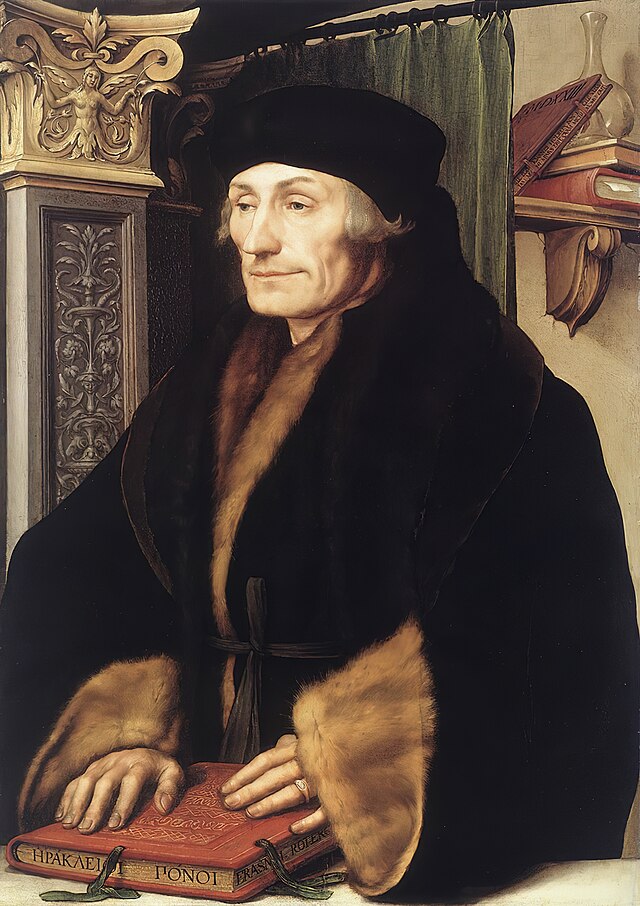
Erasmus and Budé: Frenemies forever!

Liese Dictus (KU Leuven)

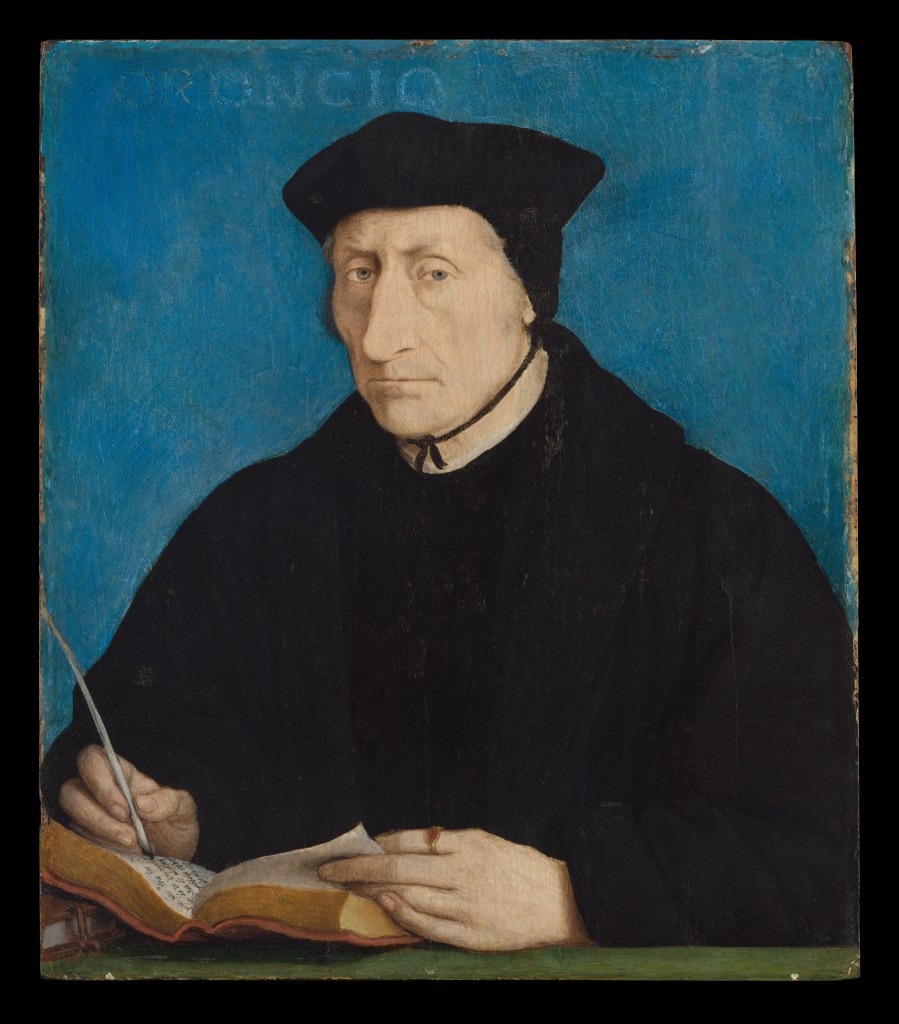
Erasmus’ sharp pen was a force to be reckoned with by his contemporaries. In his famous Praise of Folly the humanist author spared no one in society, including himself. Similarly, Erasmus proved in his letters that he could deal harsh blows with his pen strokes. A letter to the French humanist Guillaume Budé begins as follows:

Nae tu homo πάνυ βασιλικῶς munificus es, eruditissime Budaee, qui pro tam indocta epistola tam eruditam, hoc est iuxta Glaucum Homericum pro vix aerea reddideris plusquam auream, tum pro mediocri tam uberem tamque prolixam; imo non epistolam, sed volumen atque, ut melius dicam, thesaurum. (Epistula 531)

Really, my most learned Budé, what princely generosity! You have repaid my ill-educated letter with one of such exquisite learning, giving me like Glaucus in Homer more than gold for what was hardly bronze and have rewarded my mediocre performance with something so flowery and so long, it was not a letter, it was a volume, or rather a thesaurus. (translation by Mynors and Thomson)

Although Erasmus‘ opening sentence appears to be erudite and full of praise at first glance, his grotesque wording and ambiguous compliments are striking on closer inspection. The comparison of himself and Budé with the Homeric heroes Glaucus and Diomedes, as well as his climactic and exaggerated description of Budé’s previous letter as a thesaurus suggest that the friendship between the two humanists turned out to be more complex and more equivocal than one would expect.

Epistula 531 constitutes a key element in the correspondence between Erasmus and Budé. It marks the first rupture in a turbulent friendship that turned genuine affection into frustration and rivalry. Erasmus and Budé first met in Paris at the end of the 15th century. The preserved correspondence between the two humanists began around April 1516 with a letter from Erasmus to his French colleague. Budé’s experience in legal matters and his interest in philology and theology, which he shared with Erasmus, provided the two humanists with plenty of material for conversation. Soon they began to comment on each other’s work. Throughout their correspondence, the well-meant criticism became sharper and more bitter. Both Budé and Erasmus took offense at certain remarks, and misunderstandings between the two scholars continued to grow. After Epistula 531, Budé ended his communication with Erasmus. Eventually, the correspondence was resumed and carried on for a decade, although the later letters mainly dealt with mutual friends and shared opponents. The contact between Erasmus and Budé was full of friendly banter until real blows were struck and their friendship died a long and painful death.

The first signs of disagreement in the correspondence of the two humanists concern the proper use of writing style, both in Latin and Greek. Whereas Bude’s writings can be described as grand and weighty, Erasmus’ style can be characterised as lucid and accessible. The latter’s rather simple style prompted Budé’s comment in the previous Epistula 493 that Erasmus’ writings weren’t erudite enough and focused mainly on ‘futilities’, i.e. rather simple and popular genres. Although Budé formulated it in a kind manner by – likely ironically – praising Erasmus’ works, this remark seems bold and derogatory. Erasmus was dismayed and counterattacked his French colleague. The result is Epistula 531, in which Erasmus vacillates between exaggerated praise and harsh criticism. Beneath a sugar-coated layer of words hides a sharp invective.

The literary clash between Erasmus and Budé was fought with learned weapons, as befits a humanist letter. The use of Greek, for instance, proved to be formidable ammunition. Both humanists were well versed in this classical language and therefore did not hesitate to employ it in their correspondence. In a way, the use of Greek reflected the duality that the correspondence of Erasmus and Budé implied. The usage of Greek alongside Latin was not only employed in a hostile way, it also strengthened the bond between the correspondents in question. Greek was a language used only by a select audience. The bilingual communication between Erasmus and Budé was thus an acknowledgement of each other’s scholarship. From a single quotation to a full letter in Greek, their fondness for Ancient Greek manifested itself in various ways in their correspondence.

Erasmus employs code-switching in his letters to show his scholarship or to reflect his emotional commitment. Code–switches provide variety and allow him to emphasise or camouflage certain elements. A concrete example in Epistula 531 is the appearance of the Greek word ἐνθυμήματα in the following sentence: “tantum in ista tua apologia praestas artificem, cui non satis fuit omnia mea ἐνθυμήματα refellere, nisi mea tela protinus in me ipsum retorsisses, subito que ex iudice faceres reum.” Erasmus’ criticism is apparent in this statement, claiming that Budé wasn’t satisfied with defending his own stances and deemed it necessary to attack Erasmus. The latter tried to reduce his part in the conflict by presenting his remarks as less compelling, describing them as mere ἐνθυμήματα, which can be translated as ‘suggestions’. Additionally Erasmus uses several Greek proverbs from his Adagia but a number of quotes from ancient authors also appear in his letters. Besides the appearance of a Greek word in the absence of a Latin synonym, Erasmus’ fondness for compound adjectives and words with concrete, almost tangible meanings is also evident in Epistula 531. The context in which the use of Greek is situated is crucial as well. When a particular domain is associated with the Greek language, such as philosophy or rhetoric, this often results in the appearance of Greek terminology. The Greek language is furthermore a valuable medium for messages that are not meant to be read by everyone. Full sentences in Greek hide Erasmus’ negative sentiments in Epistula 531 toward some members of the clergy, who he condescendingly calls ματαιολόγοι instead of the more positive θεολόγοι.

The conflict between the two humanists forced them to get the best out of their pens. A literary battle unfolded, fought out with words, quotations and code-switches. The use of Greek proved to be an extra weapon in the arsenal, which could be used both to win people over and to inflict an extra blow on an opponent. It was a versatile tool that could be used in different ways. Code-switches are so context-specific that, in Epistula 531, they form the fine line, as it were, between friendship and enmity. As with any conflict, there were casualties. In this battle, the friendship between Erasmus and Budé perished, but the battle fought deserves a place in the literary history books.

Pictures
Bibliography
  • The full letter can be found in Allen, P.S. et al. (ed.). Opus epistolarum Des. Erasmi Roterodami Vol. 2. Oxford: Clarendon, 1906.
  • The translation of Epistula 531 can be found in Mynors, R.A.B. and D.F.S. Thomson (transl.). The Correspondence of Erasmus IV. Toronto and Buffalo: University of Toronto Press, 1977.
  • On the use of Latin-Greek code-switching in Erasmus’ letters: Rummel, Erika. “The Use of Greek in Erasmus’ Letters.” Humanistica Lovaniensia 30 (1981): 55–92.
  • On Erasmus’ and Budé’s dispute: Carrington, Laurel. “The Writer and His Style: Erasmus’ Clash with Guillaume Budé.” Erasmus of Rotterdam Society yearbook 10, no. 1 (1990): 61–84.
  • On Erasmus’ and Budé’s correspondence: De La Garanderie, Marie-Madeleine (vert.). La correspondance d’Erasme et de Guillaume Budé. Paris: Vrin, 1967.
How to cite

Dictus, Liese. 2025. “Erasmus and Budé: Frenemies forever!” Hermes: Platform for Early Modern Hellenism (blog). 1 February 2025.

Deposit in Knowledge Commons: https://doi.org/10.17613/jmq9n-1×174

A Hellenic Voice from the Tyrolean Lowlands

Tobias Heiss (Universität Innsbruck)

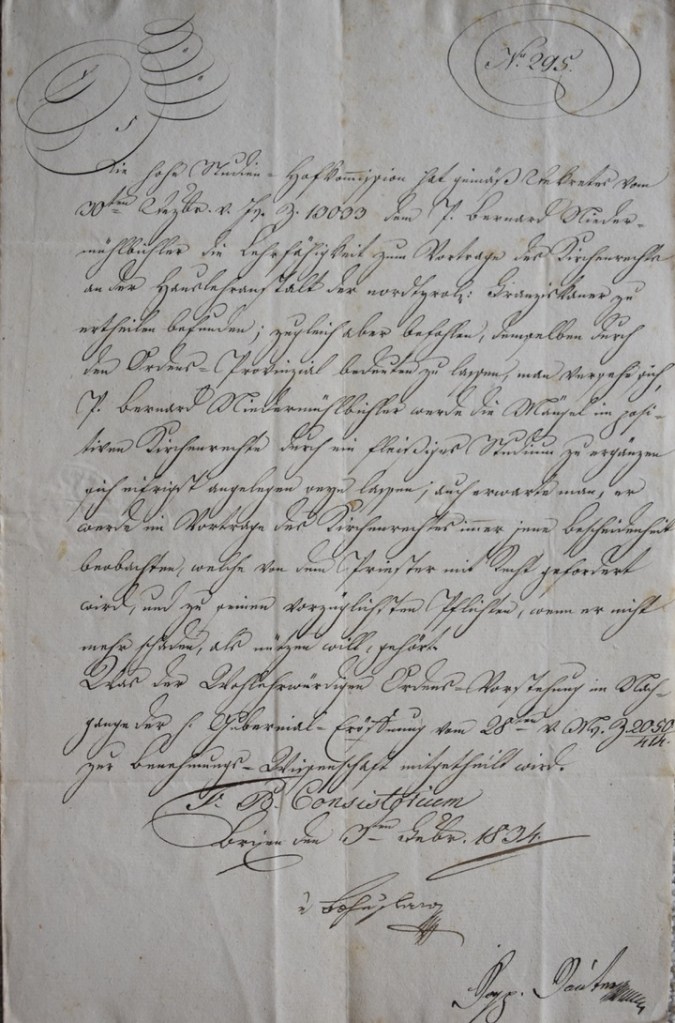
A few years before the Austrian secondary education system underwent a structural reform in 1849, which established Ancient Greek as a mandatory subject, a Franciscan monk named Bern(h)ard Niedermühlbichler (1798–1850) already published two works of exemplary New Ancient Greek versification with a pedagogical goal in mind. As a teacher of classics in Hall in Tyrol he had first-hand experience with the obstacles that prevented his students – many of them to become clergymen later themselves – to achieve a better command of Latin and Greek during and after their schooling. Niedermühlbichler himself only taught fundamental grammar at the start of his career, before he became responsible for the so-called upper Humanitätsklassen, where poetry was read more extensively. Later, he was assigned the position of prefect within the school, before he became occupied with theological studies and instruction, namely canon law and church history, at the adjoined Franciscan monastery in Hall in Tyrol.

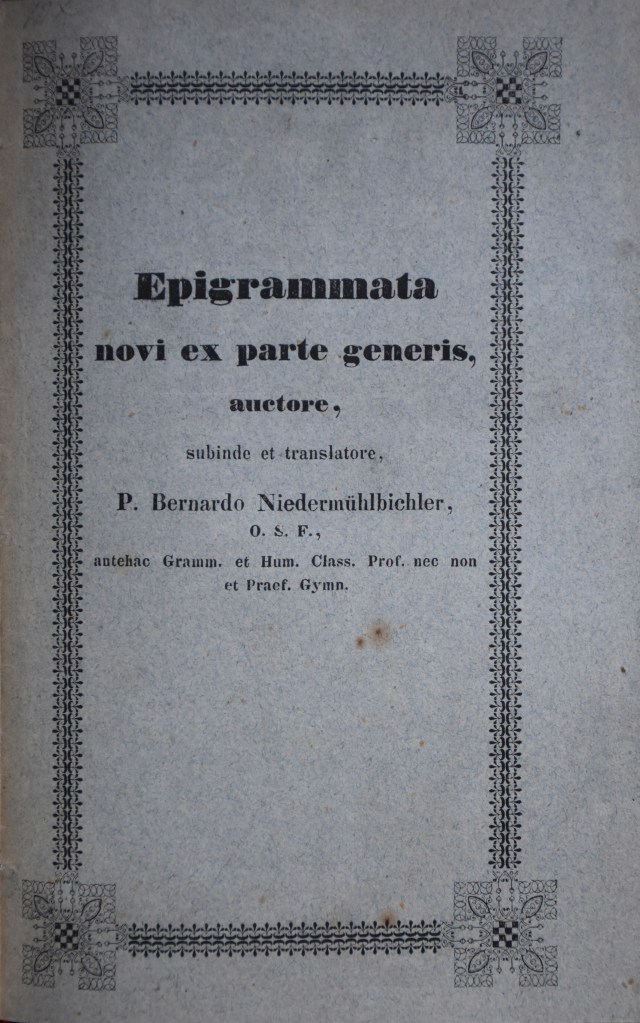
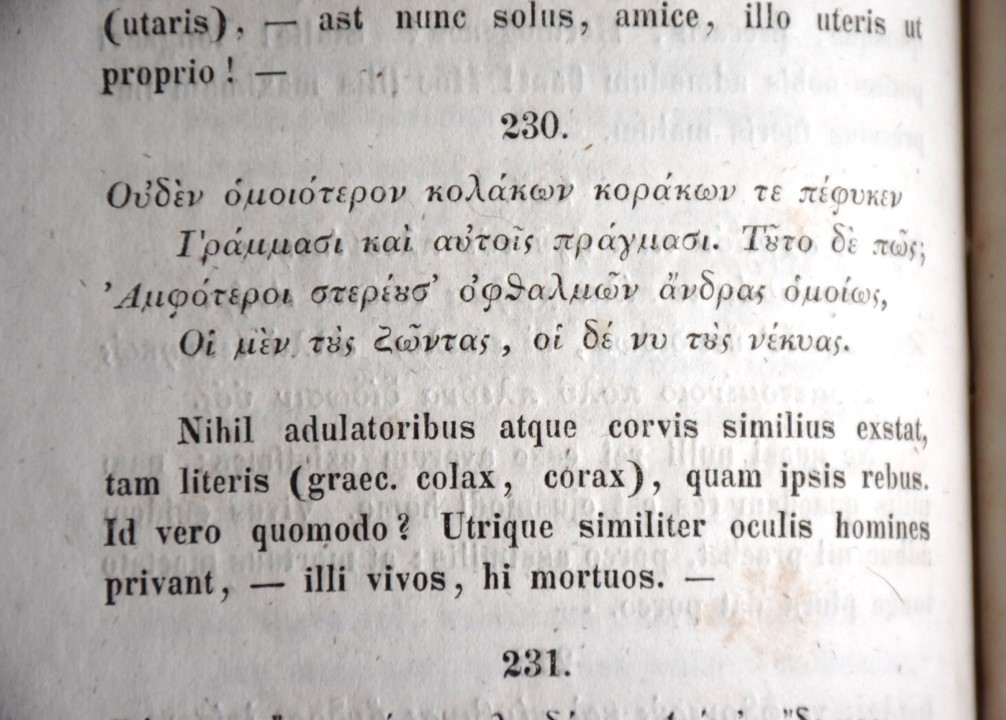
In 1844, Niedermühlbichler published a slim collection of playful Neo-Latin and Greek epigrams titled Epigrammata novi ex parte generis (Epigrams, partly of a new kind). The 225 Latin epigrams consist mostly of one- or two-liners and predominantly utilize the ambiguity of the language by means of wordplay – with an obvious example being anus in ep. 57 and 95. The twelve subsequent Greek epigrams, however, follow more traditional models. [Picture 2] Since not all readers were assumed to be fluent in poetical Greek and epigrams tend to be most effective if understood straightaway, the Greek pieces are accompanied by Latin prose translations and occasional explanatory endnotes. The poems’ themes and word choices are influenced by the epigrammatic tradition, as ep. 230 clearly shows, echoing an epigram by Palladas (Anth. Pal. 11.323):

Οὐδὲν ὁμοιότερον κολάκων κοράκων τε πέφυκεν

γράμμασι καὶ αὐτοῖς πράγμασι. Τοῦτο δὲ πῶς;

Ἀμφότεροι στερέουσ᾿ ὀφθαλμῶν ἄνδρας ὁμοίως,

οἱ μὲν τοὺς ζῶντας, οἱ δέ νυ τοὺς νέκυας.

“There is nothing that has more similarity than flatterers and ravens,
both in their letters and essence. Why is that?
Both deprive men of their eyes in a similar way,
one the living, one the dead.”

The first words οὐδὲν ὁμοιότερον allude to other epigrams from the same book of the Anthologia (cf. 11.149.2, 11.151.2) and the closing antithesis ζῶντας–νέκυας is used in good epigrammatic fashion elsewhere in Niedermühlbichler’s collection (e.g. ep. 227).

Aside from efforts of refined imitatio, one also stumbles across instances of clever puns on the peculiarity of vernacular language. As Niedermühlbichler explains in his endnotes, the following epigram 234 was written on the occasion of a speech held by a friend, who happened to be a terrible speaker:

Ὡς σὲ νεωστί, παρὼν ἅμ᾿ ἔταις πλεόνεσσι, λέγοντα

ἤκουον, Ζῆν᾿ ἦν εὖ μάλα λισσόμενος,

οὖς ἐμὲ θεῖναι ὅλως ὅλον, – ὄφρα μένοιμ᾿ ἂν ἀκουστής

ῥᾷον, μηκέτ᾿ ἔχων, οἷς ῥὰ φύγοιμι ποσίν.

“As I heard you giving a speech not too long ago with countless friends present,
I prayed deeply to Zeus,
to make me all ears, so I could remain a listener
more easily, if I had no legs, with whom I could simply take flight.”

This depiction becomes even funnier, if we bear in mind the German idiom of being very attentive and eager to listen: ganz Ohr sein (to be all ears). Though lacking an equivalent in Greek, the joke is evident for the multilingual intended reader and adds an interesting comment on the German idiom, as if being literally all ears does not leave any choice but to listen. Witty allusions like these make the epigrams worthwhile and add some spice to their otherwise moralizing content. In his Praefatio, Niedermühlbichler explicitly defends his epigrams for lacking such gustus (p. 6) and notes the difficulty of even making sense at all in these types of epigrams that are solely based on homographs and polysemy. As the Greek epigrams strongly deviate in character from the Latin epigrams, it can be argued that they are written for a more erudite audience and are set out to please readers’ expectations of the epigrammatic genre.

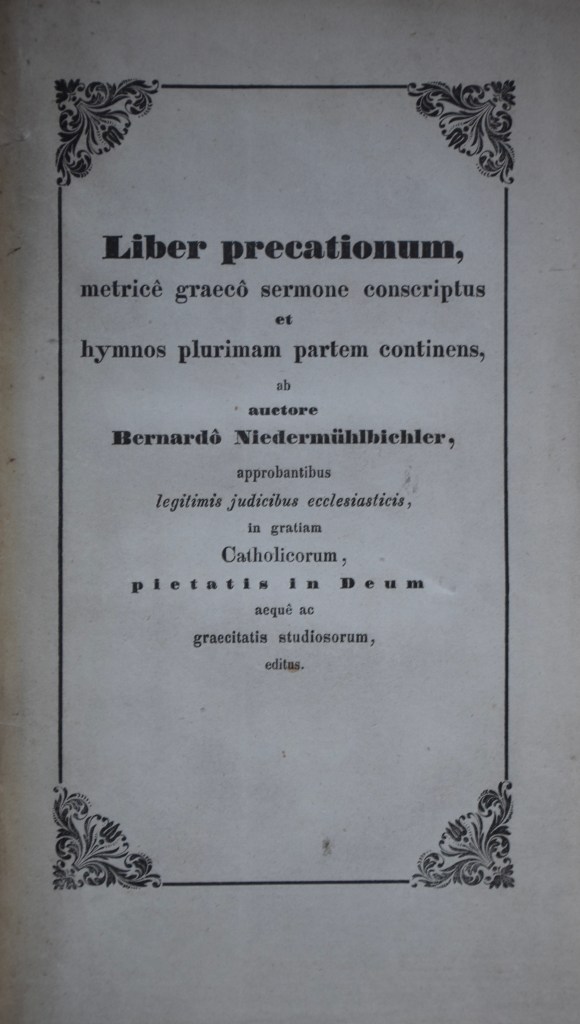
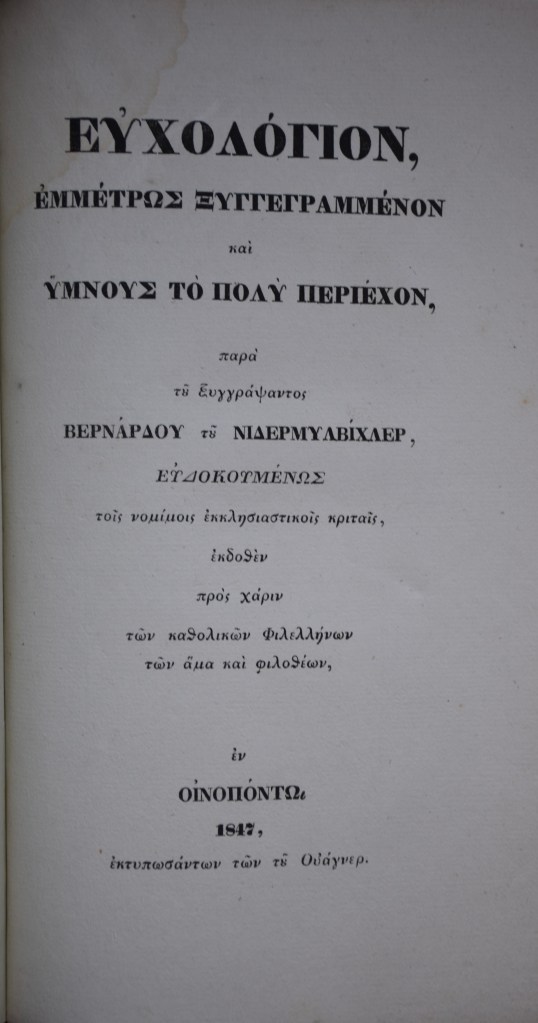
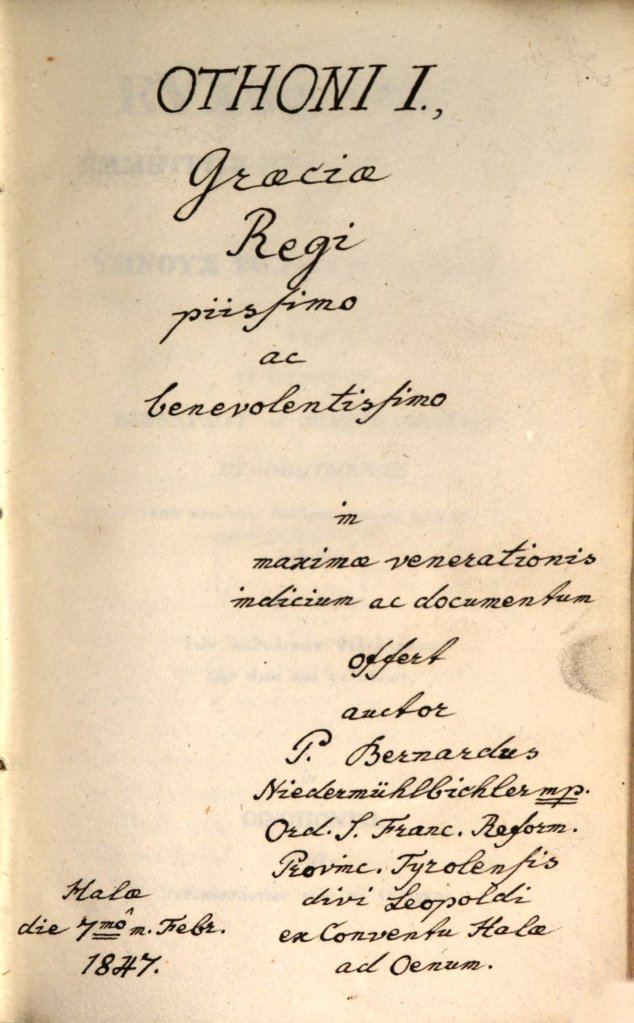
Niedermühlbichler’s command of Greek and his Hellenizing program become more evident in his tome Εὐχολόγιον (1847), a book of pious prayers in a variety of metres, written exclusively in Greek. The book opens with dedicatory hymns to Pope Gregory XVI, who passed away shortly before the publication in 1846, and king Ludwig I of Bavaria (1786–1868), whose son Otto, the first king of Greece (1815–1867), received a copy with a dedication by Niedermühlbichler on the fly leaf (Bavarian State Library Asc. 3432 f).

Niedermühlbichler expresses his views on the relation of Ancient Greek and German as part of a lengthy prologue (Πρόλογος ἀπολογητικός), defending the benefits of lifelong Greek learning even after school with the help of his book (p. XXXV):

[…] σώζοιτ᾿ ἂν […] ἐπιστήμη ἡ τῆς γλώττης, καὶ ταῦτα πολὺ τῶν ἄλλων περιούσης, τῶν ἐν τῇ Εὐρώπῃ πρεσβυτάτης, τῆς τῶν Ῥωμαίων ἐξ ἡμισείας γοῦν μητρός, αὐτῆς δὲ μάλιστα πασῶν ἐκμεμουσωμένης, λογικωτάτης τε καὶ σημαντικωτάτης ὑπαρχούσης, βραχείαις ταῖς συλλαβαῖς ὀλίγοις τε τοῖς ἔπεσι πολλὰ φραζούσης, καὶ ὅλως καλλίστης εἶναι ὡμολογημένης, ᾗτινι οὔτις ἂν τῶν νῦν ἐν ζῶσι γλωσσῶν κρατούσων περὶ τῆς ἀρετῆς καὶ πρωτείας ἐρίζοι, εἰ μὴ ἴσως ἡ τῶν Γερμανῶν διά τε ἰδίαν τινὰ δεινότητα ταύτης καὶ πολλὴν τὴν ὁμοιότητα πρὸς ἐκείνην καὶ ξυγγένειαν δέ τινὰ ἀναμφήριστον, ᾗ τὰ μὲν θυγάτηρ, τὰ δὲ καὶ ἀδελφὴ τῆς τῶν Ἑλλήνων γεγονυῖα γνωρίζεται.

“[In that way] the knowledge of the language could be preserved, which certainly surpasses all other languages, which is the oldest in all of Europe, which is seen at least half as the mother of Romans, which is the most melodious of all, and the most logical and expressive language, which can elaborate many things with short syllables and few words and which is altogether agreed upon to be the most beautiful, with which none of the languages among the living could compete in matter of excellence and rank, except perhaps the German language due to its particular exactness, the striking similarity with Greek and a certain undeniable kinship with it, which is why German is known sometimes as a daughter, sometimes as a sister, descended from the language of Greeks.”

This idea of a Greek-German kinship certainly appealed to the German royals and their aspirations in Greece at the time, who believed to be the true heirs of a noble civilization.

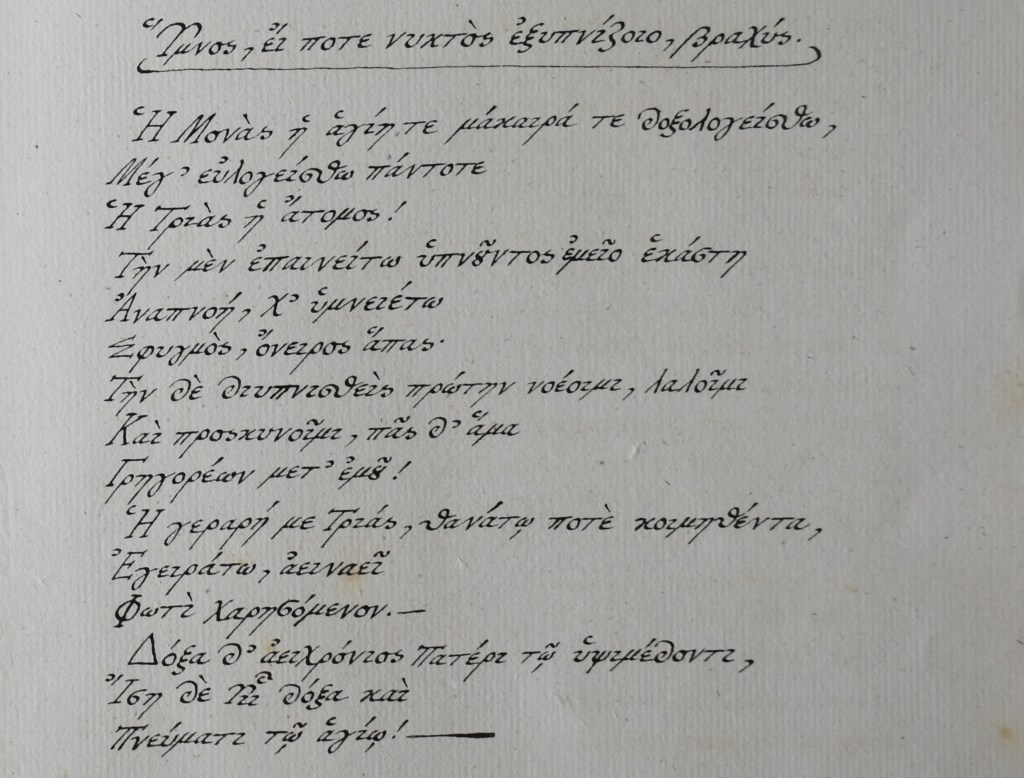
The twofold purpose of the Εὐχολόγιον is the benefit of prayer and the benefit of language learning (p. XXXIII). [Picture 6] After all, Niedermühlbichler was first and foremost a clergyman, only later to be followed by his occupation as a teacher of Greek. Because he was concerned with the place of Greek in modern times, he took it into his own hands to provide his students and other learners with daily prayers written in a language otherwise rarely used. Naturally, they should be studied repeatedly and at all sorts of different occasions, as titles like ῞Υμνος, εἴ ποτε ἐξυπνίζοιο, βραχύς (A short hymn, if you should wake up one night; p. 317) strongly suggest.

With his Εὐχολόγιον, Niedermühlbichler made an argument for Greek in terms of religious expression as well as a language of special interest for German speakers. This double aim meant that his second publication could speak to language learners, to religious leaders, and to political leaders at the same time. On the other hand, the Greek epigrams remain a hidden gem in his Epigrammata, a collection otherwise focused on the needs of Latin language learners. They may only pay off for the patient and persistent reader, a reader of the kind Niedermühlbichler distinctly wishes for at the end of his Praefatio (p. 8):

[…] Te, prudens ac benevole Lector! rogo, ut iam ad ipsa haec – a me sic dicta – epigrammata convertaris, eaque patienter legendo percurras, patienter et ipsum me feras auctorem; quem Tu si minus feres, ego Te feram, etiam plus aequo Catonem.

“I ask you, clever and kind reader, to direct your attention to just these epigrams, as I call them, already and to skim through them patiently, and, in addition to that, to put up with me, the author, in the same way. If you do not really put up with me, I shall put up with you in an even calmer manner than I do with Cato.”

Picture Captions
  • Picture 1: Official permission to teach canon law from the diocese of Brixen in 1837.
    Source: All pictures were taken by the author if not stated otherwise .
  • Picture 2: Front cover of Epigrammata novi ex parte generis (1844).
  • Picture 3: Greek and Latin text of ep. 230.
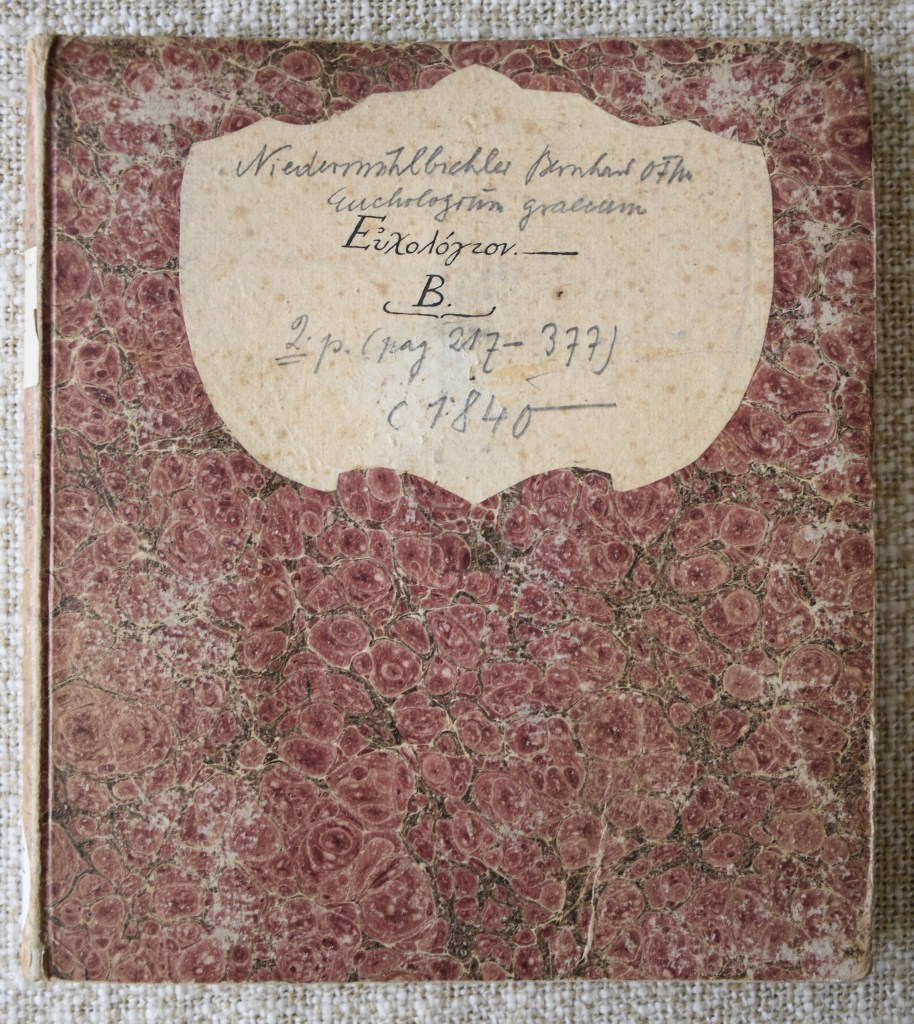
  • Picture 4: Front cover of the Εὐχολόγιον (1847) with the alternate Latin Title.
  • Picture 5: Title page of the Εὐχολόγιον (1847).
  • Picture 6: Dedication of the Εὐχολόγιον to Otto of Greece (1815–1867) on fly leaf. Source: https://www.digitale-sammlungen.de/de/view/bsb10265582 ?page=5 (last accessed: November 2024).
  • Picture 7: Part of the Εὐχολόγιον has been preserved as a manuscript at the Franciscan monastery in Hall in Tyrol (Sig. MS I 401), corresponding to pages 175–326 in print.
  • Picture 8: ῞Υμνος, εἴ ποτε ἐξυπνίζοιο, βραχύς in Niedermühlbichler’s handwriting.
Bibliography
  • Barton, William M., Martin M. Bauer and Martin Korenjak. 2022. “Austria.”In The Hellenizing Muse: A European Anthology of Poetry in Ancient Greek from the Renaissance to the Present, edited by Filippomaria Pontani and Stefan Weise, 688–721. Trends in Classics–Pathways of Reception. Berlin & Boston: de Gruyter.
  • Schaffenrath, Florian. 2012. “Von der Vertreibung der Jesuiten bis zur Revolution 1848: Dichtung.” In Tyrolis Latina: Geschichte der lateinischen Literatur in Tirol, Band II, edited by Martin Korenjak, Florian Schaffenrath, Lav Šubarić and Karlheinz Töchterle, 918–940. Wien, Köln & Weimar: Böhlau Verlag.
How to cite

Heiss, Tobias. 2024. “A Hellenic Voice from the Tyrolean Lowlands.” Hermes: Platform for Early Modern Hellenism (blog). 2 December 2024.

Deposit in Knowledge Commons: https://doi.org/10.17613/z6f78-cgc26.

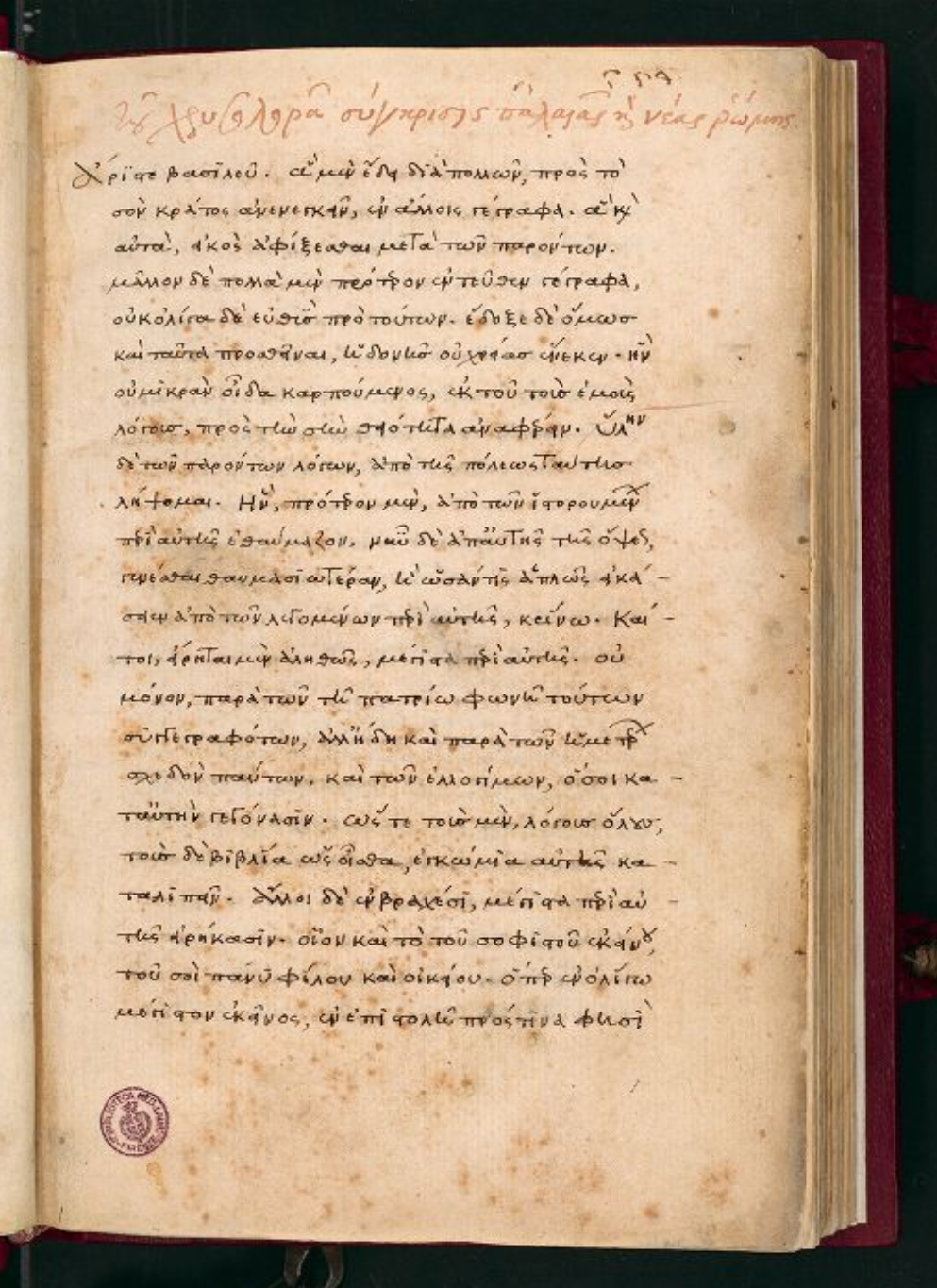
At the Dawn of Early Modern Hellenism: Manuel Chrysoloras and the Revival of Greek Studies in Renaissance Europe

Chiara Gazzini (University of Oslo)

The Steigenberger Inselhotel on Lake Constance, formerly a Dominican monastery, holds a copy of an epitaph ascribed to the Italian humanist Pier Paolo Vergerio (1370–1444/45). Originally placed near the altar of the monastery, the inscription was on the gravestone of a Greek who died in Constance on 15 April 1415 during the Council, and praises him as a highly educated, wise, and honest man. The man, celebrated in a similar inscription by Poggio Bracciolini (1380–1459) for his services to the homeland and for restoring the Greek language in Italy, is the Byzantine Manuel Chrysoloras. 

Born in Constantinople in 1360 to a noble Byzantine family, Chrysoloras was a distinguished scholar, professor, and high-ranking diplomat in the service of Emperor Manuel II Palaeologus (1391–1425) during the years of the Ottoman threat. As an imperial ambassador, Chrysoloras made his first trip to Italy sometime between 1390 and 1395, travelling to Venice with his compatriot Demetrius Kydones (c. 1324–98). On this occasion, Chrysoloras made his first contacts with the emerging world of Humanism, giving private Greek lessons to the Florentine patrician Roberto de’ Rossi (d. 1417) and attracting the attention of Coluccio Salutati (1332–1406). As chancellor of Florence, Salutati offered Chrysoloras the newly created chair of Greek at the city’s university, where the Byzantine taught from 1397 to 1400: among his students were Pier Paolo Vergerio, Leonardo Bruni (1370–1444), Jacopo d’Angelo (c. 1360–1411), and other future leaders of Italian Humanism and translators of ancient Greek literature. Chrysoloras left Florence in 1400 to join Manuel II in Lombardy, where he spent three years until 1403, dividing his time between diplomacy, teaching, and literary pursuits. One of his students at the time was Uberto Decembrio (d. 1427), a member of the Visconti intellectual circle in Pavia; with him, Chrysoloras prepared the first Latin translation of Plato’s Republic, a crucial step in the recovery and transmission of the classical heritage to the West.

In the following years, Chrysoloras was involved in diplomatic missions on behalf of Manuel II and visited some of the Western royal courts to seek aid for his besieged homeland. For the same purpose, Chrysoloras travelled to Bologna in 1410 to meet Alexander V (Peter Philarges, c. 1339–1410) but missed the opportunity due to the antipope’s sudden death. Agreeing to join the entourage of John XXIII (Baldassarre Cossa, c. 1370–1419), Chrysoloras accompanied the new antipope on his transfer to Rome in 1411 and sojourned in the city until 1413. It was a fruitful period for Chrysoloras’ cultural endeavours, as he had no official position or duties to fulfil within the papal Curia. His pupil during those years was John XXIII’s secretary, Cencio de’ Rustici (d. 1445), who later played an important role in Roman Humanism as a discoverer of manuscripts and translator of Greek texts.

The last chapter of Chrysoloras’ life coincides with the early stages of the Council of Constance, convened by John XXIII to end the Western Schism. Chrysoloras played a part in its preparation, being one of the envoys sent by the antipope to the King Sigismund of Luxembourg (1368–1437), in 1414, but it is not clear if, or how much, he contributed to its work. Although weak and ill, in Constance Chrysoloras managed to teach Greek to Bartolomeo Aragazzi (d. 1429), another prominent Italian humanist and translator, before dying on 15 April 1415. 

Among modern scholars, Chrysoloras is best remembered for his role as distinguished professor of Greek in Italy and for his pioneering contribution to the revival of Greek studies in the Renaissance. Indeed, Chrysoloras’ teaching in Florence marked a turning point in early modern cultural history, laying the foundations for a stable tradition of Greek studies in Italy and Europe. In addition, Chrysoloras’ Greek grammar, the Erotemata, served as a standard textbook for many generations to come. Later biographers hailed Chrysoloras’ coming to Florence as an epochal event, but his contemporaries did not hide their excitement either: Coluccio Salutati greeted the news of Chrysoloras’ imminent arrival as that of a new god, while Leonardo Bruni did not regret abandoning his law studies to attend Chrysoloras’ classes and learn the language that would finally enable him to “speak” with Homer, Plato, and Demosthenes. This is perfectly in keeping with the cultural climate of late fourteenth-century Florence and the trends specific to Salutati’s circle. At the same time, it reflects, at least in part, Chrysoloras’ own vision of his activity in the West. This is clear from the fortnight of Greek and Latin letters that make up the bulk of Chrysoloras’ oeuvre: especially when writing to his students, the Byzantine praises the ancients as the supreme source of intellectual nourishment and notes the importance of getting a reliable picture of their works by reading them in the original language. However, Chrysoloras attached far greater importance to his cultural endeavours, which had the same motives and aims as his diplomatic service to the imperial authority. Realising, like most contemporary Byzantines, that what was left of the Empire was doomed by the advance of the Turks, Chrysoloras’ argued in his letters that a survival of Byzantium was still possible by preserving its literary heritage. For Chrysoloras, this was both a political and civic responsibility. Writing to Manuel II, he urged him to do everything in his power to prevent the loss of the rich culture that Byzantium had inherited from the ancients, aware that this would lead to the country’s ultimate downfall. For his part, Chrysoloras contributed to the goal in many ways during his lifetime: as a diplomat, promoting reconciliation between East and West; as a teacher, passing on the legacy of Greek language and literature to the Latin-speaking world; and, finally, as an epistolographer, with letters that reveal his personality, his acquaintances, his scholarly tastes, but also his efforts to build a bridge between East and West, to re-establish in the present the intimate “communion” between the two great civilisations of the ancient world, and the strength of their common culture.

Pictures
Bibliography
  • Cammelli, G. I dotti bizantini e le origini dell’Umanesimo, I: Manuele Crisolora, Firenze, Vallecchi, 1941.
  • Gamillscheg, E. “Ch(rysoloras), Manuel”, Lexikon des Mittelalters, II, Stuttgart–Weimar, Metzler, 1999, 2052–53.
  • Gazzini, Ch. ‘L’edizione delle epistole di Manuele Crisolora. Status quaestionis e prospettive di ricerca’, Annali dell’Istituto universitario Orientale di Napoli. Sezione filologico-letteraria 38, 2016, 119–78.
  • Maisano, R. – Rollo, A. Manuele Crisolora e il ritorno del greco in occidente. Atti del Convegno Internazionale (Napoli, 26-29 giugno 1997), Napoli, Istituto Universitario Orientale, 2002.
  • Mergiali-Sahas, S. “Manuel Chrysoloras (ca. 1350-1415), an Ideal Model of a Scholar-Ambassador, Byzantine Studies / Études Byzantines, n.s. 3, 1998, 1–12.
  • Rollo, A. Gli Erotemata tra Crisolora e Guarino, Messina, Centro Interdipartimentale di Studi Umanistici, 2012.
  • Thorn-Wickert, L. Manuel Chrysoloras (ca. 1350-1415). Eine Biographie des byzantinischen Intellektuellen vor dem Hintergrund der hellenistischen Studien in der italienischen Renaissance, Bonner romanistische Arbeiten 92, Frankfurt a.M.-Berlin etc., Peter Lang, 2006.
  • Trapp, E. et al. “Χρυσολωρᾶς Μανουήλ (Chrysoloras Manuel)”, Prosopographisches Lexicon der Palaiologenzeit, XII, Wien, Verlag der Österreichischen Akademie der Wissenschaften, 1994, nr. 31165.

How to cite

Gazzini, Chiara. 2024. “At the Dawn of Early Modern Hellenism: Manuel Chrysoloras and the Revival of Greek Studies in Renaissance Europe.” Hermes: Platform for Early Modern Hellenism (blog). 1 October 2024.

Deposit in Knowledge Commons: https://doi.org/10.17613/z55a-6y21.