Laura Truzzu (KU Leuven)
Erasmus of Rotterdam’s edition of the New Testament is a monument to early modern bilingual scholarship. Published in 1516 as the Novum Instrumentum, it presented a Greek text of the New Testament, the first ever to appear in print, alongside a revised Latin translation, supplemented by an extensive collection of annotations. The Greek text was based on a collation of medieval Byzantine manuscripts and followed the majority reading of the New Testament, supported by most of the surviving Greek manuscripts.[1] The Latin translation was based on the Vulgate, which it revised in accordance with the Greek text and rendered in a classical style. The annotations provided a rationale for the new translation and served as a running commentary on the language, history and content of the New Testament books. [2]
Surrounding these core components – Greek text, Latin translation and annotations, which would recur in all subsequent editions (1519, 1522, 1527 and 1535) – were several Greek and Latin paratexts. The most famous were the Paraclesis, Methodus and Apologia, prefatory essays outlining Erasmus’ program for religious reform (fig. 1). They encouraged readers, particularly theologians, to engage with Scripture personally and critically. Personally, by reading the sacred texts themselves rather than through medieval anthologies. Critically, by studying the ancient languages in which these texts were originally composed as well as by consulting the Church Fathers, whom Erasmus considered the most reliable guides to biblical exegesis.[3] Underlying these essays was the idea of Scripture as literature, as a collection of multilingual texts written by different authors, across different time periods and cultures, and therefore in need, as was any other ancient corpus, of careful (re-)contextualization.[4] The theologian’s task then lay in restoring the original meaning of the biblical text and rendering it intelligible and appealing to a contemporary audience. For the former, he must employ the philological-historical methods of classical humanism. For the latter he must follow the example of the Church Fathers who, by means of rhetoric rather than dialectic, conveyed the true and timeless message of Scripture, referred to by Erasmus as the Philosophia Christi.[5]
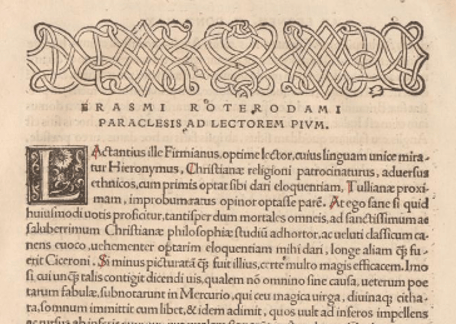
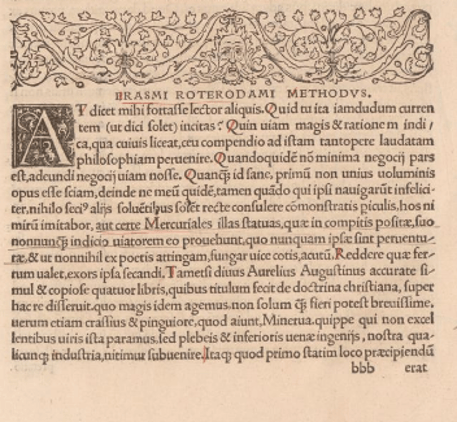
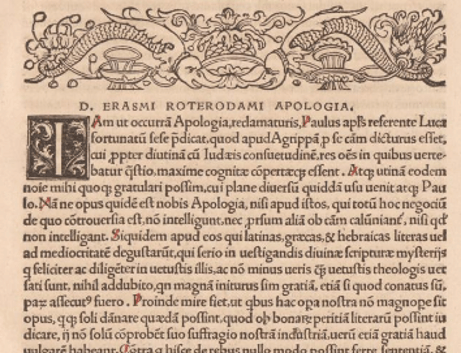
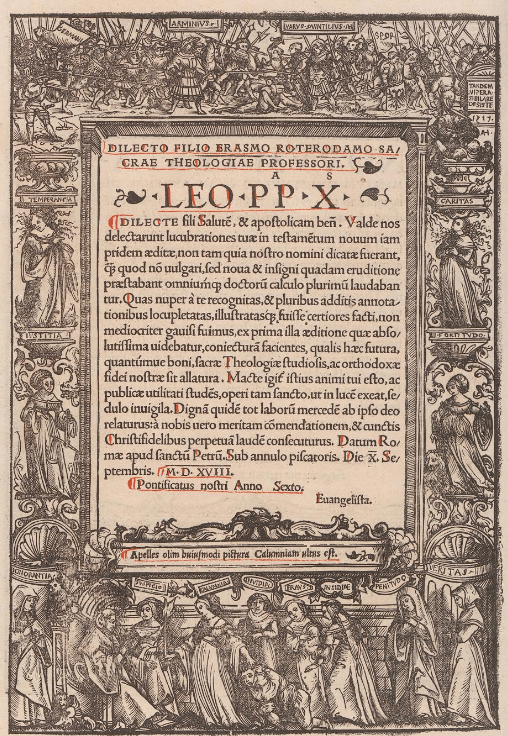
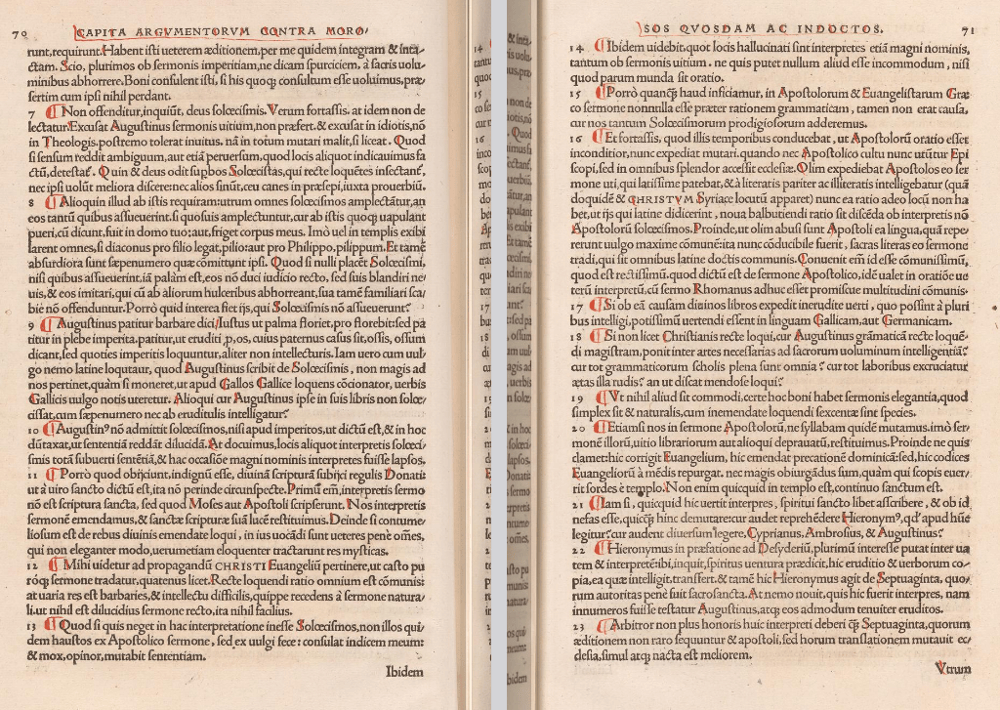
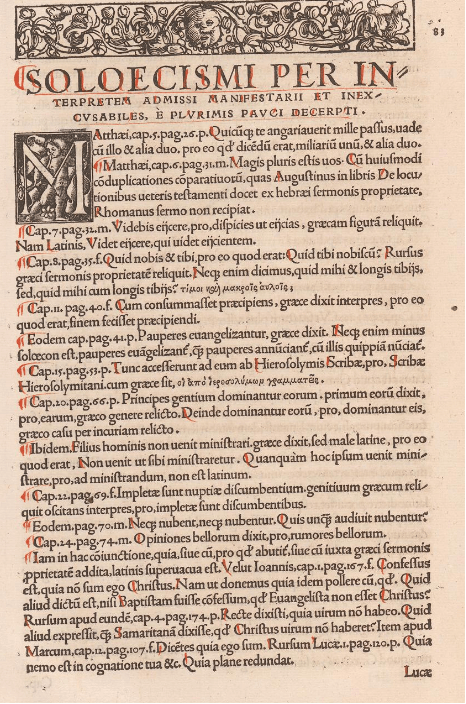
The Paraclesis and Methodus eventually developed into autonomous essays, reprinted and sold separately from the Novum Instrumentum while the Apologia continued to preface the work in all subsequent editions.[6] From 1519 onward, these essays were supplemented by a series of polemical paratexts that defended the now renamed Novum Testamentum against growing criticism. Amid the rising tensions of the Reformation, the work became increasingly controversial because it treated the Vulgate as a translation that could be revised and improved rather than a sacrosanct text impervious to change. By implication it seemed to challenge the authority of the Catholic Church that sanctioned the primacy of the Vulgate as the sole and divinely inspired Latin version of Scripture.[7] To counter these objections, Erasmus prefaced the 1519 edition with Pope Leo X’s letter granting permission for its publication (fig. 2). This was followed by the Capita argumentorum contra morosos quosdam ac indoctos (Chief Points in the Arguments Answering Some Crabby and Ignorant Critics), a passionate apology refuting his – conspicuously anonymous – opponents (fig. 3); and by the Elenchi or Indices, a catalogue of erroneous, obscure and corrupt passages in the Vulgate (fig. 4). In doing so, Erasmus reaffirmed that the Vulgate was a translation in need of revision, while simultaneously reassuring his readers that such revisions enjoyed papal approval and were not intended to challenge the privileged status of the Vulgate nor to replace it as the official text of the Catholic Church. They were only meant to help theologians understand Scripture more accurately and accommodate its message to a contemporary audience, catering to their refined (humanistic) tastes.[8]
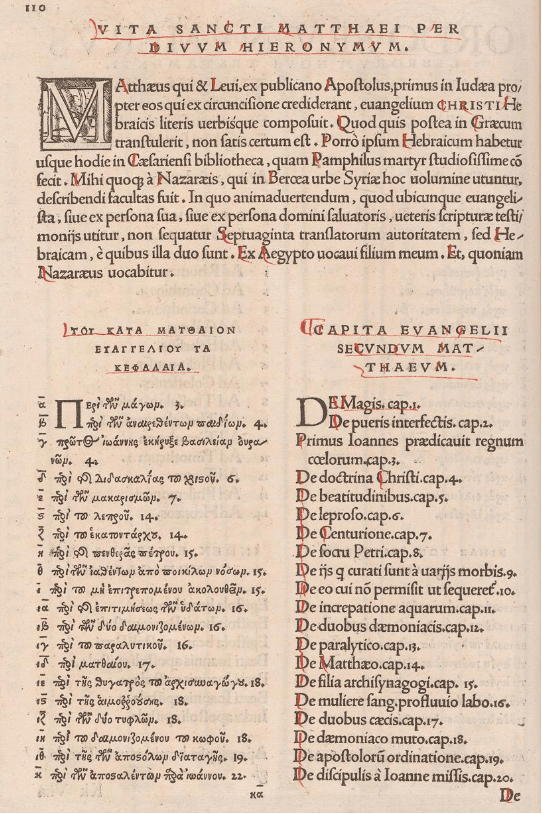
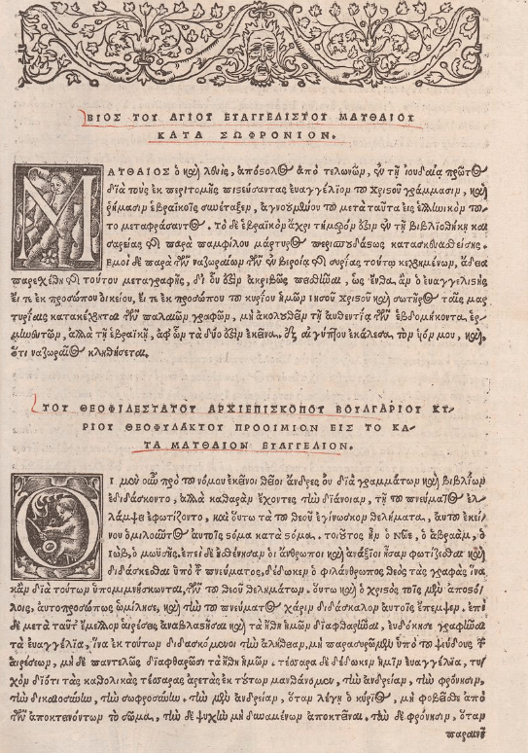
Alongside these lengthy essays and polemical pieces, Erasmus also included a series of shorter paratexts surrounding the individual books of the Gospels, Acts and the Epistles. They were mostly biobibliographical in nature, outlining the lives of the biblical authors and the content and characteristics of their writings. Most of these paratexts were adopted from the Church Fathers or from the editorial apparatus of the Greek and Latin manuscripts Erasmus used for his revised editions, although some were compositions of his own. The Gospels, for example, were prefaced by Latin biographies of the evangelists, adopted from Jerome’s De Viris Illustribus (fig. 5); by their Greek translations, falsely attributed to his friend Sophronius; and by Greek summaries or hypotheseis derived from Theophylactus’ commentary on the Gospels (fig. 6).[9] Acts was introduced by two Greek treatises on the missionary travels and martyrdom of the apostle Paul, anonymously transmitted through the Byzantine tradition. In 1527 they were supplemented by Erasmus’ own chronological survey of the travels of Peter and Paul, written in Latin (fig. 7).[10] The Epistles, meanwhile, were prefaced from 1516 onward by Greek hypotheseis and Latin argumenta, brief summaries passed down anonymously through the Byzantine and Vulgate traditions respectively (fig. 8). At the end of each Pauline Epistle also appeared bilingual subscriptions recounting the letter’s place of composition, secretary and courier. These subscriptions were originally attested only in Greek, but in 1516 Erasmus provided his own Latin translation (fig. 9).[11] While the hypotheseis and subscriptions recurred in all subsequent editions, the argumenta were replaced by Erasmus’ own summaries in 1519 (fig. 10). These summaries elaborated on the content and style of the letters, as well as their moral relevance to everyday life, topics he had already introduced in the Paraclesis, Methodus and Apologia and would develop further in his annotations.[12]
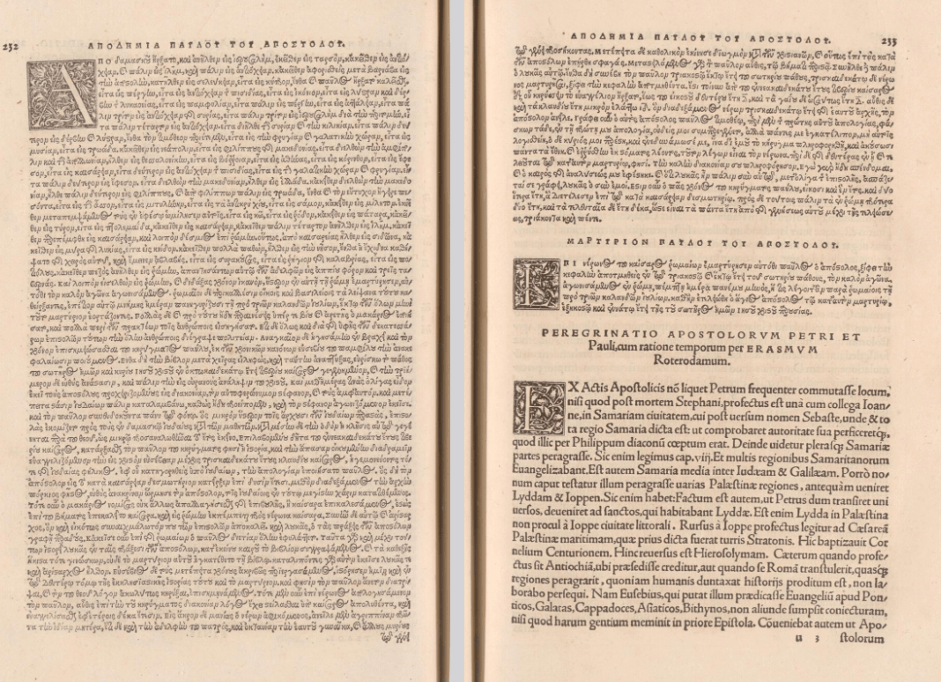
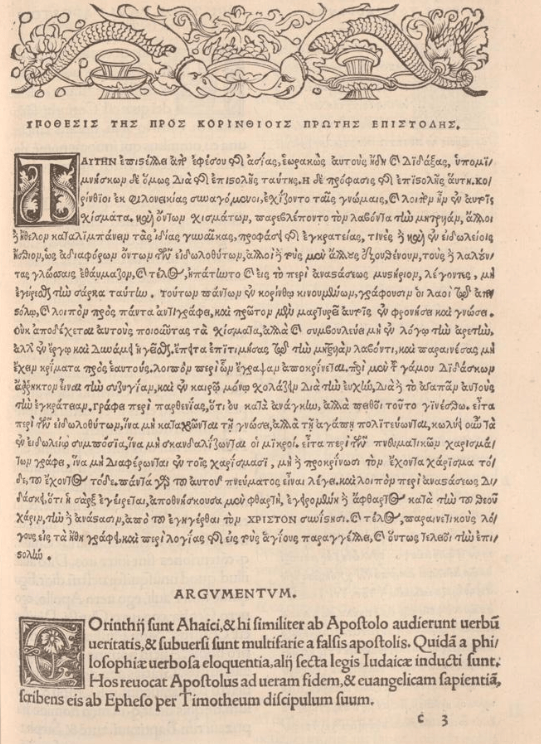
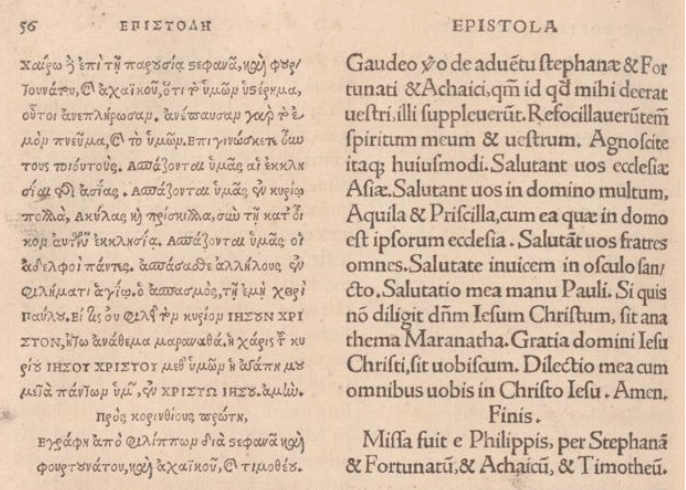
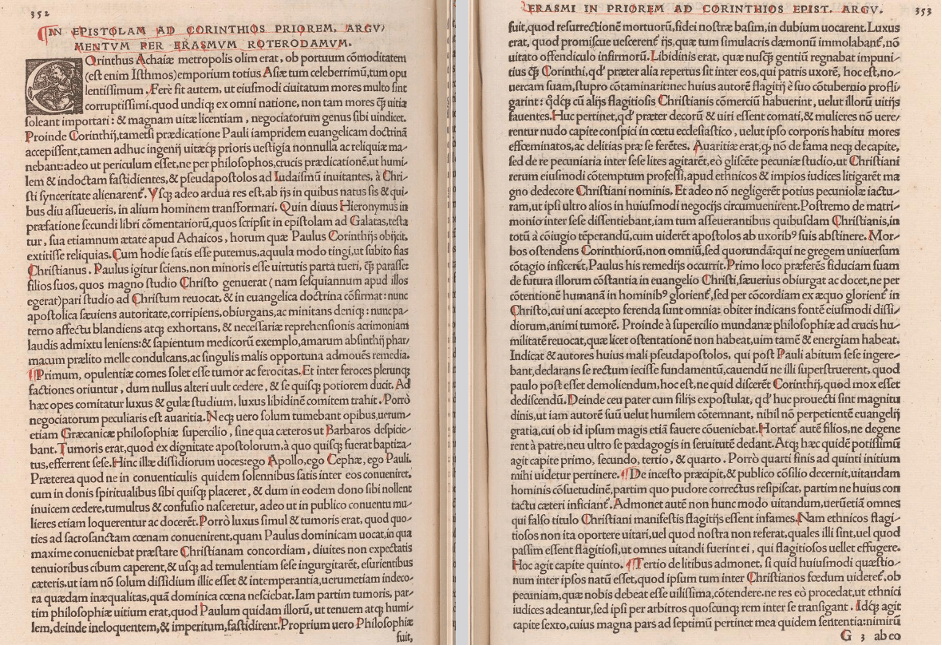
These biobibliographical paratexts embedded the Novum Testamentum within an ancient, and authoritative, tradition of biblical scholarship, emphasizing the continuity of the work rather than its innovation, as did the prefatory essays discussed above. They privileged the Church Fathers (e.g. Jerome) and their Byzantine commentators (e.g. Theophylactus) over the scholastic theologians, whom they did not mention at all. They also seemed to reveal a hierarchy between the Greek and Latin manuscript traditions in which these patristic and scholastic bodies of scholarship were respectively rooted. Whereas the editorial features of the Greek tradition were adopted without alteration (e.g. hypotheseis, subscriptions), those of the Latin tradition, most notably the argumenta, were replaced by Erasmus’ own compositions, further distancing the Novum Testamentum from the Vulgate and reaffirming the primacy of the Greek tradition.[13] Alternatively, or perhaps additionally, this asymmetry may reflect the different functions of the Greek and Latin paratexts. The former connected the edition to an established tradition, while the latter provided room for Erasmus’ own contributions to it. This would support the commonly held view that the Novum Testamentum was primarily a Latin edition of the New Testament, despite its (historically significant) inclusion of the Greek text. This text served only to support the revision of the Vulgate but was otherwise of secondary importance.[14] The paratexts would then reflect a similar instrumental use of Greek alongside a more original use of Latin.
In conclusion, the paratextual apparatus of the Novum Testamentum was an integral part of all major editions – although often omitted in the minor ones, which aimed to be more accessible[15] – and it served different functions. The lengthy essays prefacing the work were manifestos of biblical humanism, which made a passionate plea to read the Bible and, by studying classical philology and rhetoric, to restore its original text and meaning. The polemical pieces defended against accusations of blasphemy, assuring its readers that the Novum Testamentum did not undermine the primacy of the Vulgate nor the authority of the Catholic Church, but was only meant as an academic tool or instrumentum for the study of Scripture. The biobibliographical paratexts lend credence to this claim by situating the work within the patristic and Byzantine traditions of biblical learning, emphasizing alike its orthodoxy and its scholarly character. Although the apparatus consisted of both Greek and Latin paratexts, only some of the latter were original compositions. This provided further evidence for the instrumental use of Greek throughout the Novum Testamentum, which was primarily conceived as a Latin text. Although originally assigned a minor and supportive role, the Greek text accompanying Erasmus’ Latin translation would have a lasting impact on the history of bilingual biblical scholarship, serving as the textus receptus of the New Testament well into the nineteenth century[16] – an ironic outcome the author himself might not have anticipated, but would have appreciated, nonetheless.
References
Amalou, Thierry and Alexander Vanautgaerden, eds. 1516. Le Nouveau Testament d’Érasme. Regards sur l’Europe des humanistes. Turnhout: Brepols, 2020.
Bloemendal, Jan. “Erasmus and Biblical Scholarship.” In A Companion to Erasmus, edited by Eric MacPhail, 68-89. Leiden and Boston: Brill.
Cummings, Brian. “Erasmus, Sacred Literature, and Literary Theory.” In Erasmus on Literature. His Ratio or ‘System’ of 1518/1519 (The Ratio verae theologiae), edited by Mark Vessey, 48-62. Toronto, Buffalo and London: University of Toronto Press, 2021.
de Jonge, Henk Jan. “Erasmus’ Novum Testamentum of 1519.” Novum Testamentum 61, no. 1 (2019): 1-25.
de Jonge, Henk Jan. “Erasmus’s Translation of the New Testament: Aim and Method.” The Bible Translator 67, no. 1 (2016): 29-41.
de Lang, Marijke H. “Fidelius, apertius, significantius: The New Testament Translated and Edited by Erasmus of Rotterdam, 1516.” The Bible Translator 67, no. 1 (2016): 5-8.
Elliott, James Keith. “Novum Testamentum editum est: The Five-Hundredth Anniversary of Erasmus’s New Testament.” The Bible Translator 67, no. 1 (2016): 9-28.
Faber, Riemer. “The Argumentum as Paratext: Editorial Strategies in the Novum Testamentum.” Erasmus Studies 37, no. 2 (2017): 161-175.
Faber, Riemer. “The Ratio and Annotations as Theory and Practice of Biblical Interpretation.” In Erasmus on Literature. His Ratio or ‘System’ of 1518/1519 (The Ratio verae theologiae), edited by Mark Vessey, 80-92. Toronto, Buffalo and London: University of Toronto Press, 2021.
Seidel Menchi, Silvana and Carlo Martino Lucarini, eds. Scripta Minora ad Novum Testamentum Pertinentia. Opera Omnia Desiderii Erasmi Roterodami vol. VI-11. Leiden and Boston: Brill, 2025.
Wallraff, Martin. “Paratexte der Bibel: Was Erasmus edierte außer dem Neuen Testament.“ In Basel 1516: Erasmus’ Edition of the New Testament, edited by Martin Wallraff, Silvana Seidel Menchi and Kaspar von Greyerz, 145-173. Tübingen: Mohr Siebeck, 2016.
Footnotes
[1] James Keith Elliott, “Novum Testamentum editum est: The Five-Hundredth Anniversary of Erasmus’s New Testament,” The Bible Translator 67, no. 1 (2016): 19-22; Andrew J. Brown, “The Manuscript Sources and Textual Character of Erasmus’ 1516 Greek New Testament,” in Basel 1516: Erasmus’ Edition of the New Testament, ed. Martin Wallraff, Silvana Seidel Menchi, and Kaspar Von Greyerz (Tübingen: Mohr Siebeck, 2016), 126-130 and 137-138.
[2] Marijke H. de Lang, “Fidelius, apertius, significantius: The New Testament Translated and Edited by Erasmus of Rotterdam, 1516,” The Bible Translator 67, no. 1 (2016): 5-6.
[3] Silvana Seidel Menchi and Carlo Martino Lucarini eds., Scripta Minora ad Novum Testamentum Pertinentia, Opera Omnia Desiderii Erasmi Roterodami vol. VI-11 (Leiden and Boston: Brill, 2025), 19-21.
[4] For a detailed discussion of Erasmus’ literary theory and his concept of historical and rhetorical accommodatio see Brian Cummings “Erasmus, Sacred Literature, and Literary Theory,” in Erasmus on Literature. His Ratio or ‘System’ of 1518/1519 (The Ratio verae theologiae), ed. Mark Vessey (Toronto, Buffalo and London: University of Toronto Press, 2021), 48-62; and Riemer Faber, “The Ratio and Annotations as Theory and Practice of Biblical Interpretation,” in Idem, 80-92.
[5] Jan Bloemendal, “Erasmus and Biblical Scholarship,” in A Companion to Erasmus, ed. Eric MacPhail (Leiden and Boston: Brill, 2023), 77, 83 and 88; and Seidel Menchi and Lucarini, 17 and 21-22.
[6] Seidel Menchi and Lucarini, 13n70. The Methodus was later renamed the Ratio verae theologiae (1518/1519) and expanded into a treatise on (biblical) literature and hermeneutics. It served as a manual for Erasmus’ philological and historical method of biblical interpretation. See n4.
[7] Idem, 42-46.
[8] Idem, 29-32; Henk Jan de Jonge, “Erasmus’s Translation of the New Testament: Aim and Method,” The Bible Translator 67, no. 1 (2016): 30-34.
[9] Martin Wallraff, “Paratexte der Bibel: Was Erasmus edierte außer dem Neuen Testament,“ in Basel 1516, 160-162; de Jonge, “Erasmus’ Novum Testamentum of 1519,” Novum Testamentum 61, no. 1 (2019): 14; Thierry Amalou and Alexander Vanautgaerden ed., 1516. Le Nouveau Testament d’Érasme. Regards sur l’Europe des humanistes (Turnhout: Brepols, 2020), xiv-xv.
[10] Wallraff, 153; de Jonge, “Erasmus’ Novum Testamentum of 1519,” 15; Amalou and Vanautgaerden, xiv-xv.
[11] Wallraff, 148-152; de Jonge, “Erasmus’ Novum Testamentum of 1519,” 15-16; Amalou and Vanautgaerden xvi-xix.
[12] For an in-depth survey of the argumenta see Riemer Faber, “The Argumentum as Paratext: Editorial Strategies in the Novum Testamentum,” Erasmus Studies 37, no. 2 (2017): 161-175.
[13] Wallraff, 149.
[14] de Jonge, “Erasmus’ Novum Testamentum of 1519,” 5-9.
[15] Seidel Menchi and Lucarini, 46-53.
[16] Elliott, 22-24.
How to cite
Truzzu, Laura. 2026. “Greek and Latin Paratexts in the Novum Testamentum.” Hermes: Platform for Early Modern Hellenism (blog). 28 October 2026.
Deposit in Knowledge Commons: http://doi.org/10.17613/txrkk-cva70.

