Tobias Heiss (Universität Innsbruck)
Writing Greek verse takes practice. So much so that the better part of New Ancient Greek poetry was never intended to have a broader readership at all. Scribblings, attempts, and exercises are easily discarded, especially by authors who have outgrown them.[1] In this context, the translation of Latin poems into Greek was a common exercise. The process required an excellent knowledge of Latin and Greek, an awareness of register and genre, and the ability to work with metrical constraints. In other words, it was a perfect pedagogical instrument. But what if such an exercise in translation grows to be something more serious?
In December 1625, the German University of Altdorf (Nuremberg) hosted a celebratory Christmas oration. Normally, this task would have fallen to one of the enrolled students. For a special visitor, however, an exception was made: the wandering Greek Orthodox scholar Metrophanes Kritopoulos (Μητροφάνης Κριτόπουλος, ca. 1589–1639).[2] Since his arrival in Altdorf a month prior, the learned society had been keen on meeting the stranger from afar. Questions about his customs, his theological views, and his pronunciation of Greek had already been discussed.[3] The Greek professor Georg Queck (1561–1628), however, wanted to give him a proper stage and invited him to deliver a festive oration on Christmas day. Both honored and indebted to his host, Kritopoulos did so in the presence of the rector, students, and representatives of society. Notably, the oration was given in Ancient Greek and printed soon afterward together with a Latin translation by Queck.
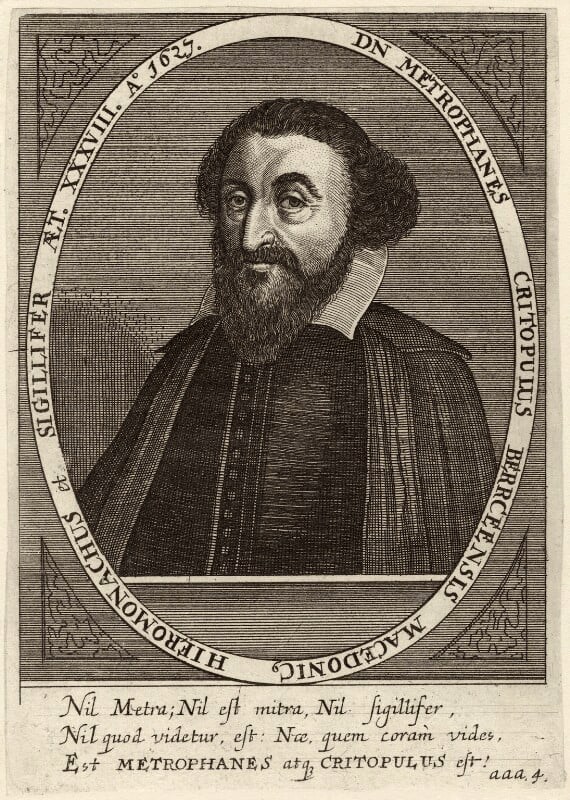
In my post, I will not discuss this long oration, which deserves closer study, but I will focus on a Greek poem that was appended to the published oration. The title reads: “Carmen in natalem Christi salvatoris nostri, e Latina Elegia P. Lotichii Graecè redditum ante XXV. annos à Melchiore Rindero” (trans. “A Song in Honor of the Birth of Christ Our Savior, a Latin Elegy by Petrus Lotichius Translated into Greek 25 Years Ago by Melchior Rinder” [4]). The translator Melchior Rinder (1581–1634) was the Minister of Nuremberg’s St Sebaldus Church and a former student of the Academy in Altdorf. More importantly, he had personal connections with Kritopoulos. “Whenever I came from Altdorf to Nuremberg,” Kritopoulos stated in a letter to Wolfgang Jacob Pömer (1590–1655) dated May 15, 1626, “Rinder’s house was open to receive me” (ὁσακις γὰρ Ἀλτορφίηθεν εἰς Νωριμβέργαν ἐγενόμην, ἀνῳγμένη μοι ἦν εἰς ὑποδοχὴν ἡ ἐκείνου [sc. Ῥινδέρου] οἰκία[5]). In that light, it is not particularly surprising that Rinder made a contribution to a publication of his dear friend. But why did Rinder decide to reach back to an old piece from his student days in Altdorf? And why did he choose to express his friendship through a translation rather than an original composition?

To follow this line of inquiry, let us first turn to the source of the translation. Petrus Lotichius Secundus (1528–1560) was a prominent German Neo-Latin poet and highly regarded by 17th-century readers.[6] He was known in particular for his elegies, striking both in their poetical immediacy and in their blending of classical sources. The elegy in question was first printed in 1548 and quickly became a valued model, on which German humanists like Johann Bocer, Nikolaus Reusner, and Martin Opitz later built. In 180 lines, it tells the story of Christ’s birth and closely echoes the events of Luke 2:1–20. However, Lotichius puts specific emphasis on the soteriological fate of Christ and the hardships endured by Mary and Joseph.
Melchior did not simply translate Lotichius’ elegy into Greek, but transferred it to a wholly different genre. Written in hexameter and filled with numerous references to the Homeric epics, it makes for a genuine epyllion. Was he ambitious or did he simply adhere to an assigned task? We cannot discard one possibility for the other, as such exercises were commonly used in curricula.[7] However, his intentional shift of genre is made clear from the beginning. He deliberately omits the first 12 lines from Lotichius’ poem in order to call upon Christ in the epic fashion of an invocation (vv. 1–6):
Σωτῆρος μερόπων τὸ γενέθλιον ἦμαρ ἀείδειν
ἄρχομαι ἐμμαπέως, μάλα δυσμαρὲς ἔργμα τελέσσαι·
Χριστὲ θεοῦ υἱὸς πατρὸς ὑψιμέδοντος, ἀπ᾽ ἄκρου
δεῦρ᾽ οὐλύμποιο στήθεσσιν ἐμοῖσιν ὀπάζων
ἄρρηκτον φωνὴν, ὀπὶ λειριοέσσῃ ἀοιδὴν
μέλπεσθαι γλυκερὴν ἐπὶ σεῖο γενέθλιον ἦμαρ.[8]
To sing of his birthday, the savior of all mortals,
let me eagerly begin, for it is an awe-inspiring task to complete:
Christ, son of God, the Father ruling on high, from the summit
of Mount Olympus, come hither, bestow upon me and my heart
an unbreakable voice, a sweet song as pure as lilies
to celebrate the day of your birthday.
The combination of ἄρχομαι (“I begin”) and ἀείδειν (“to sing”) is a recurring incipit of the Homeric Hymns (HH 2.1, 11.1, 13.1, 16.1, 22.1, 26.1, 28.1). Furthermore, attributes of Zeus are used to describe the Christian god: He is ὑψιμέδων(“ruling on high”) and lives on Mount Olympus. Christ is called upon to leave his father’s side, come down from heaven, and help the poet in need. Thus, Christ replaces the ancient Muses. In comparison, the corresponding lines in Lotichius create a different atmosphere (vv. 13–16):
Ipse canam dulces numeros: adhibere sacratis
Piërios aris fasque piumque modos.
Tu modo, Christe, meum pectus vocemque guberna,
vera Dei effigies progeniesque patris.[9]
I myself will sing sweet verses: to add poetic chants
to sacred altars is both right and dutiful.
You alone, Christ, guide my heart and voice,
true image of God and son of the Father.
Here, the relationship between poet and Christ seems to be more intimate. Ipse (“Myself”) and tu modo (“You alone”) are set in striking opposition, which almost invites us to imagine the scene of a private prayer. Such affective intimacy is well in line with the generic conventions of elegy, especially Roman elegy. The passage, as a result, lacks all the grandeur of Rinder’s translation. More than something to be admired in themselves, the verses are brought forth as humble offerings.
One last question remains: why did Rinder choose this text? One could obviously point to the fact that it was thematically well suited. However, the poem could serve another purpose. The University of Altdorf had only recently acquired the status of a full university, something Kritopoulos himself mentions with great effect in his own speech. Nonetheless, it had been a place of learning since 1575 and had made a name for itself as the Academia Norica. By presenting his friend with a Greek piece from his early 20s, Rinder offered more than a simple congratulatory poem on the occasion. It was a testament to the longstanding engagement with Greek letters on the university’s ground. In terms of content, it recounts the story of a family seeking shelter amidst hostile forces. At the time of the Thirty Years’ War, Kritopoulos had personally experienced Rinder’s hospitality in Nuremberg, but through the printed poem he stepped into local intellectual history and, by means of a shared language, could feel at home.
References
Blair, Ann M., “The Making of Student Notes”, in Student Notes from Latin Europe (1400–1750): A Research Companion ed. Xander Feys, Maxime Maleux, Andy Peetermans and Raf Van Rooy. Leuven: Leuven University Press, 2025, 27–48.
Coppel, Bernhard, “Zur Einführung in das Thema: Petrus Lotichius Secundus”, in Lotichius und die römische Elegie ed. Ulrike Auhagen and Eckart Schäfer. NeoLatina 2. Tübingen: Gunter Narr Verlag, 2001, 11–17.
Davey, Colin, Pioneer for Unity, Metrophanes Kritopoulos (1589-1639) and Relations between the Orthodox, Roman Catholic and Reformed Churches. London: British Council of Churches, 1987.
Kritopoulos, Metrophanes, Λόγος πανηγυρικὸς, ἅμα καὶ δογματικός, Oratio panegyrica et dogmatica. Altdorf: Balthasar Scherff, 1626.
Legrand, Émile, Bibliographie Hellénique ou description raisonnée des ouvrages publiés par des grecs aux XVe et XVIe siècles. Vol. 2. Paris: Ernest Leroux, 1885.
Lotichius, Petrus, Petri Lotichii Secundi Solitariensis Poëmata Omnia, ed. Pieter Burman. Amsterdam: Officina Schouteniana, 1754.
Ordo quatuor facultatum sive brevis descriptio praelectionum, & exercitationum Academiae Altorphinae. Altdorf: Nicolaus Knorr, 1586.
Saracino, Stefano, Griechen im Heiligen Römischen Reich: Migration und ihre wissensgeschichtliche Bedeutung. Cultures and Practices of Knowledge in History 19. Boston/Berlin: Walter de Gruyter, 2024.
Footnotes
[1] However, attention has been drawn to the value and availability of student notes from the Early Modern period. Cf. Blair (2025).
[2] Within the Early Modern period, the mobility of Greeks was surprisingly high. Cf. Saracino (2024).
[3] Personal connections to the university society are recorded by autographs in Kritopoulos’ album amicorum. As far as the nature of the inquiries is concerned, Kritopoulos’ name featured in different scientific writings published in Altdorf. Cf. Davey (1987), 199.
[4] All translations from Latin and Greek are my own.
[5] Cited by Legrand (1885), 221–22.
[6] Coppel (2001) offers some basic information about the work, life, and reception of Lotichius.
[7] The curriculum of the Altdorf Academy is noteworthy in its extensive use of classical Greek and Latin sources across all four faculties (theology, law, medicine, and art). It subsumes Latin-to-Greek or Greek-to-Latin-translations under “exercitationes Classicae partim in loquendo et scribendo, Latine, & Graece, tam versu, quam prosa”. Cf. Ordo quatuor facultatum (1586).
[8] Kritopoulos (1626), Gv.
[9] Lotichius (1754), 309.
How to cite
Heiss, Tobias. 2026. “Hospitality and a Translation into Greek” Hermes: Platform for Early Modern Hellenism (blog). 4 November 2026.
Deposit in Knowledge Commons: https://doi.org/10.17613/0y0m7-thj75

