Pieter-Jan Mannens (KU Leuven)
Anyone wishing to study bilingualism in Roman literature is reliant on written sources that have been handed down to us by medieval scribes. Errors inevitably creep into the text during the copying process, and matters become particularly difficult when a scribe has to copy passages that he or she can barely read or understand. As the critical apparatuses of modern editions often show, Greek passages in Latin works can be so corrupted in transmission that numerous conjectures occur in different editions. In this blog post, I would like to highlight the need for a standardised approach to deal with multilingual texts by sharing some observations on and examples of the problematic textual transmission of Greek passages in Latin works, drawn from my own research into Latin-Greek code-switching (i.e. alternation between two or more languages in the same discourse) in Latin satire of Lucilius, Varro, Martial and Juvenal.
First of all, I would like to illustrate the problems of transmission and conjecture using a famous quotation often discussed in relation to Latin-Greek bilingualism: Catullus, Carm. 12.13, which is in fact a reconstructed form.
verum est mnemosynum mei sodalis.1
But it’s a memento of my friend.2
Est mnemosynum was reconstructed from the manuscript readings est nemo sinum (X)3 and nemo est sinum (O).4 In his Venetian edition of 1481, Italian scholar Giovanni Calfurnio (1443–1503) proposed giving the form a Greek ending, mnemosynon. John M. Trappes-Lomax (2007, 63) follows the conjecture of Calfurnio and believes that, given the corrupt transmission, both the stem and the ending can be corrected because “Catullus would not have spoiled the effect by giving it a Latin ending and pretending that it was naturalized in Latin.” In my view, this assertion is not strongly supported: firstly, because Trappes-Lomax based his argument on his personal aesthetic intuition, secondly because the conjecture mnemosynon lacks direct manuscript support, while mnemosynum appears to offer a more plausible explanation of the transmitted corruptions. Moreover, there are no other examples of Greek endings on –on in Catullus’ work. Whatever the case may be, humanists such as Desiderius Erasmus (1469–1536) and Justus Lipsius (1547–1606) must have regarded the form as purely Greek, as they even went a step further and wrote it using the Greek alphabet. According to the Library of Latin Texts both scholars cite μνημόσυνον nineteen and three times respectively in their works, e.g. Erasmus, Epist. 222.21, his dedicatory letter to Thomas More (ca. 1478–1535) of The Praise of the Folly, presumably from 1509:
Hanc igitur declamatiunculam non solum lubens accipies ceu μνημόσυνον tui sodalis, verum etiam tuendam suscipies, vtpote tibi dicatam iamque tuam non meam.
You will therefore not only be happy to accept this tiny little speech as a memento of your friend, but you will also take it under your protection, since it has been entrusted to you and is now yours, no longer mine.
Such distortions in the preserved texts are best understood in the context of the decline of Greek studies between the 5th and 6th centuries (Rollo 2023, 23). Knowledge of Greek remained part of the Western cultural universe until the 11th or 12th century, although limited to the mastery of the alphabet and its sounds and reserved solely for monks who had been specially trained for this purpose (Rollo 2023, 28-29, 44). Since all didactic material for Greek available in the Western Middle Ages dated from late antiquity, Greek letters were consequently transmitted throughout the Middle Ages in fixed capital letters, while in Byzantium the switch to minuscule script had already taken place (Rollo 2023, 24-25, 30). In his 2023 monograph I graeca nel De vita caesarum di Svetonio, Antonio Rollo examines the medieval transmission of the Greek passages in Suetonius’ De vita Caesarum. He argues that alternative readings of Greek passages in manuscripts are primarily due to the formal or phonetic similarity between the Greek letters of late antique capital script. According to Rollo (2023, 34), there was considerable confusion in the manuscripts between the triangular letters alpha (Α), lambda (Λ) and delta (Δ), between the round letters such as theta (Θ), omicron (Ο), the epsilon lunatum (ϵ) and the sigma lunatum (C), between the square letters eta (Η), ny (Ν) and pi (Π), between the letters ypsilon (Υ) and psi (Ψ), and between the letters gamma (Γ) and tau (Τ). Furthermore, sequences of letters such as gamma (Γ), pi (Π), iota (Ι) or tau (Τ) can also lead to numerous corruptions in the written tradition. In addition, Rollo (2023, 44) argues that many corruptions can also be attributed to the late antique pronunciation of Greek, leading to considerable confusion between, for example, E, H, EI and I, as well as between AI and E. Moreover, Rollo (2023, 35-36) contends that letters that were incorrectly transcribed or omitted in a manuscript were inevitably passed on to the copies based on it, as the scribes’ knowledge of the Greek language was insufficient for noticing and correcting them. Having applied Rollo’s methodology to my corpus, I found several examples of textual corruption caused by the confusion of letters in the textual tradition. One of them is Varro, Men. 30 (ed. Krenkel 2002), transmitted in Nonius, De compendiosa doctrina, (ed. Lindsay 1903, 50):
non mirum si caecutis; aurum enim non minus praestringit oculos quam ὁ πολὺς ἄκρατος
No wonder you’re blind; after all, gold dazzles the eyes no less than plenty of undiluted wine.
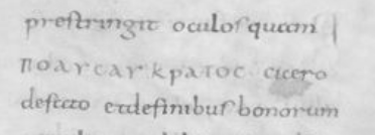
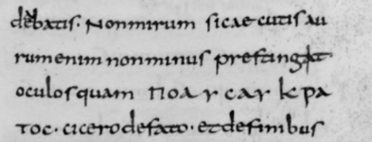
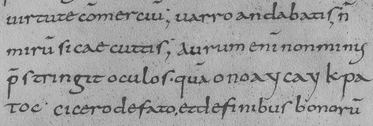
ὁ πολὺς ἄκρατος, as it appears in modern editions (Cèbe 1972, 112; Astbury 1985, 5; Krenkel 2002, 56), is a conjecture proposed by the French Hellenist Adrianus Turnebus (1512–1565) in 1565. The manuscripts show confusion between the triangular letters Λ and Α of πολύς: manuscript L5 (Figure 1) and its copy F6 (Figure 2) both have ΠΟΑΥCΑΥΚΡΑΤΟC; in G7 (Figure 3) the article is suggested by the omicron in front, OΠΟΑΥCΑΥΚΡΑΤΟC.8
Something similar occurs in Lucilius, Saturae 303 K (ed. Krenkel 1970), cited in Nonius (ed. Lindsay 1903, 480):
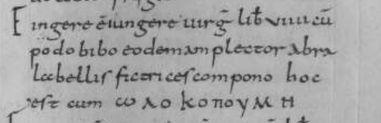
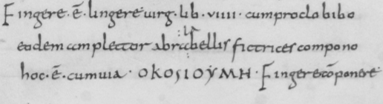
cum poclo bibi eodem, amplector, labra labellis fictricis conpono, hoc est cum ψωλοκοποῦμαι
When I drink from the same cup, embrace it, and press my lips against the lips of a female statue, that’s what happens when I have erection problems.
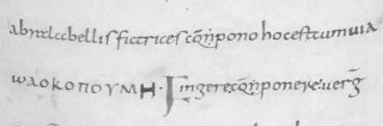
If Hadrianus Iunius’ conjecture from 1565 of the form ψωλοκοποῦμαι (a compound of ψωλός [‘with the glans visible, ‘erect’] and κοπόομαι [‘to become exhausted’]) is correct, we once more observe confusion between A and Λ as well as the repercussions of phonetic similarity between AI, E and H. L reads ωAΟΚΟΠΟΥΜΗ (Figure 4), G reads ωΛΟΚΟΠΟΥΜΗ (Figure 5) and Gen9 reads ΟΚΟſ ΙΟΥΜΗ (Figure 6).10 In Gen the first two letters which are present in L and G are missing, and there possibly was a confusion between Π and the combination of S (ſ ) and I.
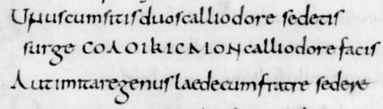
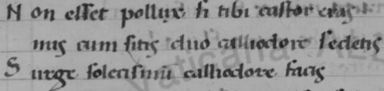
To summarise, the insufficient Greek knowledge of scribes led to severe textual corruption, resulting in various conjectures proposed by text editors throughout history. That’s the first problem. The second lies in the fact that many Greek passages were handed down to us in the Latin alphabet. In such cases, it is not always clear whether transcription reflects the author’s choice or the manuscript tradition. Cèbe (1972, 63) argues that transcriptions may occur, for example, if a manuscript has been copied under dictation. However, there are examples that rule out such dictations (see Figure 11). In the work of Martial, we find several examples of Greek segments which, in one branch of the manuscript tradition, were copied in Greek script, whilst in the other branch they were transcribed. For example, the γ-branch, including a 10th-century manuscript X, reads in Epigr. 5.38.8 CΟΛΟΙΚΙCΜΟΝ (figure 7),11 while the β-brach, including the 15th-century manuscript P,12 reads the transliterated form solecismum (Figure 8).
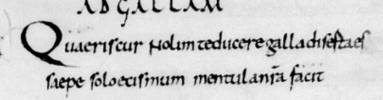

It is worth noting that, in the case of Martial, a large number of passages, which modern editions13 write in Greek, in fact are preserved in all manuscripts in Latin script. Some examples: μισῶ μνάμονα συμπόταν (Epigr. 1.27.7) appears in the manuscripts as mis omne monasympoten; τὸν δ᾽ ἀπαμειβόμενος (Epigr. 1.45.2) as tondapamibomenon; ἔχεις ἀσώτως (Epigr. 4.9.3) as exisasotos.14
In Nonius p. 756 Lindsay, where Varro, Men. 41 is cited, we can see the transcription happening before our eyes. The text in Krenkel (2002, 73) reads:
‘Polliceres’ pro pollicereris. Varro Ἀνθρωποπόλει, περὶ γενεθλιακῆς: ‘nam in omnibus <nominibus> legi ‘kath’hyperbaton’, ne dares, ne polliceres quod datum est’.
‘Polliceres’ instead of ‘pollicereris’. Varro wrote in Anthropopolis, about astrology: ‘for I have read everywhere that one ought not to have given “excessively” nor promised what had already been given’.
In the manuscripts, the Greek text has come down to us in a highly distorted form. Figure 11 shows the fragment in the 10th-century manuscript G:
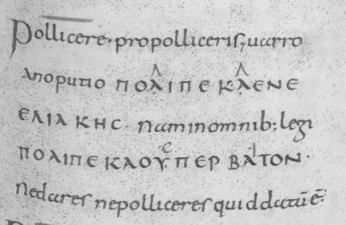
The first letters of the title of Varro’s satire Ἀνθρωποπόλει are preserved in this manuscript in the Latin alphabet (anoputio); the scribe then switches to capital letters for the Greek characters (ΠΟΑΙΠΕΚΑΕΝΕΛΙΑΚΗC). It is highly unlikely that Nonius wrote down that title in two different scripts in this way. This example also shows that, in this case, the transcription was not made by dictation, as the (presumably) original Greek was imitated by the scribe in lowercase script. Note, incidentally, that there is once again confusion here between the round letters O and Θ (ΚΑΟΥΠΕΡΒΑΤΟΝ) – at least, if Buechler’s conjecture is correct.
Most importantly, the transcription of Greek passages across critical editions lacks uniformity. When Erich Woytek (1970, 50) briefly discusses the contemporary editions in his monograph on Varro’s Menippeae, he rightly states that the choice of alphabet when publishing Greek passages is rather “eine reine Geschmacksache” (“a matter of pure personal taste”) on the part of the publisher. In critical editions, the practice therefore appears highly arbitrary: sometimes a Greek segment transcribed in the manuscripts is rendered in Greek characters, while at other times the transcribed form is retained. In Lucil., Sat. 499 K, for example, Krenkel transcribes the poeticon handed down in the manuscripts as ποιητικόν, while in Varro, Men. 58, where the manuscripts likewise read poeticon, he leaves the form in the Latin alphabet. Sometimes, however, the reverse also occurs. As in the aforementioned Men. 41, where all manuscripts transmit Greek characters, Krenkel chooses to transcribe ‘kath’hyperbaton’, whereas other editors such as Cèbe (1974, 144) and Astbury (1985, 7) do retain the Greek script (καθ’ ὑπέρβατον). In this case, I do not consider Krenkel’s transcription to be ideal. In light of Rollo (2023, 35–36), who argues that misinterpreted or omitted Greek letters are bound to remain incorrect or become even more corrupted in all copies, it is unlikely that the reverse would occur, with originally Latin letters being spontaneously converted by scribes into the (poorly mastered) Greek alphabet. If, therefore, all manuscripts read Greek letters, it seems plausible to me that the original was also intended to be Greek.
With this blog post devoted to the problematic textual transmission of Greek segments in Latin texts, I wish to make it clear to the reader that one should be very cautious when consulting modern editions. Greek passages as they appear in editions today were often reconstructed from corrupted manuscript readings, leading to an explosion of conjectures by scholars over time. As a result, almost every edition of a bilingual text offers a significantly different version. Furthermore, the alphabet in which a passage appears in an edition today offers little or no guidance for the correct identification of code-switches: firstly, because transcriptions do not necessarily originate from the author themselves, and secondly, because there is a considerable lack of uniformity among publishers regarding the use of the alphabet. Uniformity across different editions is also lacking. In my view, there is a need for a common approach that enables publishers to handle bilingual texts consistently (e.g. universal guidelines for deciding whether a foreign word should be transliterated or not, …), so that the editions could be used responsibly for academic research.
Manuscripts
Città del Vaticano, Biblioteca Apostolica Vaticana, Pal. lat. 1696.
https://digi.vatlib.it/view/MSS_Pal.lat.1696
Firenze, Biblioteca Medicea Laurenziana, Plut. 48.1.
Genève, Bibliothèque de Genève, lat. 84.
https://iiif.biblissima.fr/collections/manifest/d4bb438cd1aeb6a5d7cfe6f13d2443b7447e7873
Leiden, Universiteitsbibliotheek, Voss. lat. fol. 73.
https://digitalcollections.universiteitleiden.nl/view/item/4118139#page/1/mode/1up
Paris, Bibliothèque nationale de France, lat. 8067.
https://gallica.bnf.fr/ark:/12148/btv1b9078255c.r=latin%208067?rk=21459;2
Wolfenbüttel, Herzog August Bibliothek, Cod. Guelf. 96 Gud. lat.
https://diglib.hab.de/wdb.php?dir=mss/96-gud-lat&imgtyp=2&size=
References
Astbury, Raymond. M. Terentii Varronis Saturarum Menippearum fragmenta. Leipzig: Teubner, 1985.
Bardon, Henricus. Catulli Veronensis Carmina. Stuttgart: Teubner, 1973.
Cèbe, Jean-Pièrre. Varron, Satires Ménippées: édition, traduction et commentaire, vol. 1-13. Rome: École française de Rome, 1972–1999.
Eisenhut, Werner. Catulli Veronensis liber. Leipzig: Teubner, 1983.
Krenkel, Werner Arno. Lucilius: Satiren, vol. 1-2. Leiden: Brill, 1970.
Krenkel, Werner Arno. Marcus Terentius Varro: Saturae Menippeae, vol. 1-4. St. Katharinen: Scripta Mercurae Verlag, 2002.
Shakleton Bailey, David Roy. M. Valerii Martialis Epigrammata. Stuttgart: Teubner, 1990.
Rollo, Antonio. I graeca nel De vita caesarum di Svetonio: la tradizione medievale. Messina: Centro Internazionale di Studi Umanistici, 2023.
Trappes-Lomax, John. Catullus: A Textual Reappraisal. Swansea: The Classical Press of Wales, 2007.
Woytek, Erich. Studien zur Satura Menippea Varros. Vienna: Böhlau, 1970.
Footnotes
- The Latin text was taken from Werner Eisenhut’s Teubner-edition (1983, 10). ↩︎
- All translations in this blog post are mine. ↩︎
- X denotes the common ancestor of the 14th-century manuscripts G (Paris, Bibliothèque nationale de France, lat. 14137) and R (Città del Vaticano, Biblioteca Apostolica Vaticana, Ott. lat. 1829), see Bardon (1973, IX). ↩︎
- Oxford, Bodleian Library, Canonici lat. 30 (14th century). ↩︎
- Leiden, Universiteitsbibliotheek, Voss. lat. fol. 73 (9th century). ↩︎
- Firenze, Biblioteca Medicea Laurenziana, Plut. 48.1 (9th century). ↩︎
- Wolfenbüttel, Herzog August Bibliothek, Cod. Guelf. 96 Gud. lat. (10th century). ↩︎
- Sigla are taken from Krenkel (1970, 43-45). ↩︎
- Genève, Bibliothèque de Genève, lat. 84 (9th century). ↩︎
- Sigla taken again from Krenkel (1970, 43-45). ↩︎
- Paris, Bibliothèque nationale de France, lat. 8067 (10th century). ↩︎
- Città del Vaticano, Biblioteca Apostolica Vaticana, Pal. lat. 1696 (15th century). ↩︎
- For my research, I used the 1990 Teubner edition edited by Shakleton Bailey. ↩︎
- This list is by no means exhaustive. ↩︎
How to cite
Mannens, Pieter-Jan. 2026. “Eine reine Geschmacksache: textual criticism of Latin-Greek code-switching in Roman satire.” Hermes: Platform for Early Modern Hellenism (blog). 28 October 2026.
Deposit in Knowledge Commons: https://doi.org/10.17613/0m1w7-ekk57

